
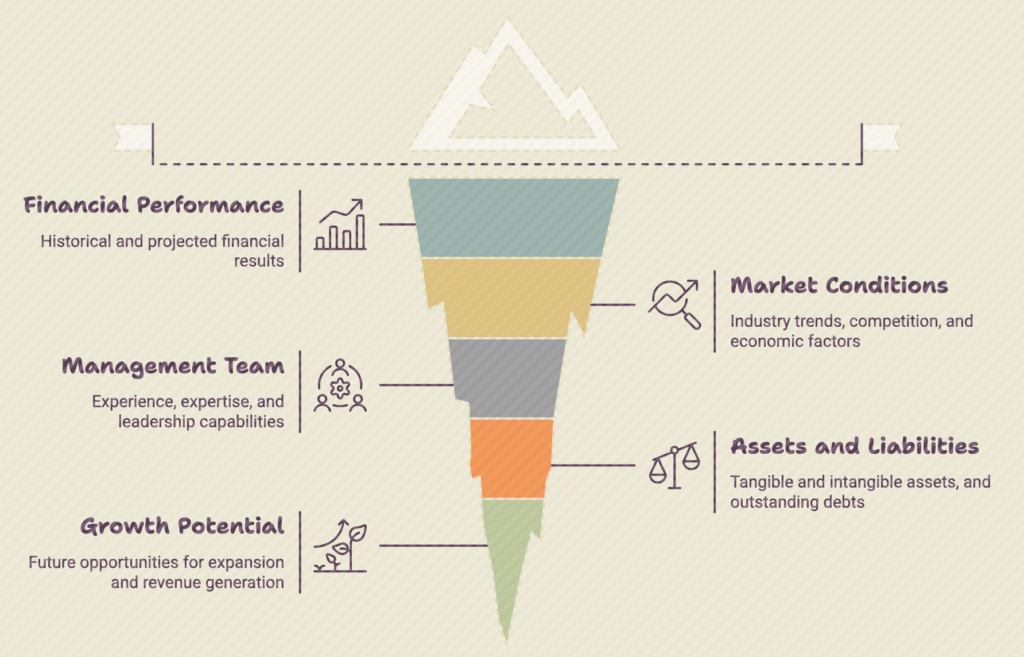
A formal valuation of a business is a structured, evidence-based assessment of what your company is worth, prepared to a recognised professional standard and set out in a way that a third party can rely on. That third party might be a buyer and their advisers, HM Revenue and Customs, a lender, a court, or a fellow shareholder. It is very different from a figure you reach over a coffee or a number a competitor once mentioned, because it shows its workings: the method used, the financial evidence, the adjustments made to the accounts, and the assumptions applied. It also expresses value as a considered range rather than a single tidy number, because that is how the market behaves.
For most owner-directors, the business is the largest asset they will ever hold, yet it is the one they understand least in pure value terms. You know your turnover, margins, and best customers, but you may have far less sense of what a buyer would pay, how a tax office would view a share transfer, or how a judge might treat the company in a dispute. A formal valuation closes that gap. Having valued and sold companies across many sectors over more than fifteen years, we find that owners who start with a realistic, well-evidenced figure end up in a stronger position than those who start with hope. If you are already weighing up a move, understanding valuation properly is the first practical step towards selling your business on the right terms.
This page sits at the top of our valuation resources and links down to the detailed guides.
Formal valuation versus a rough estimate versus an asking price
These three numbers are often confused, and the confusion costs owners money. Knowing the difference protects you at the negotiating table.
A rough estimate is a quick indication of value, usually based on a rule of thumb such as a simple multiple of profit or turnover. It is useful for a first sense of scale and nothing more, because it ignores the specifics that determine real worth and can be badly wrong in either direction. Treating a rule of thumb as a settled valuation is one of the most common early mistakes.
A formal valuation is the considered version. It takes the same starting evidence, the trading accounts, and works through it properly: normalising the figures, testing more than one method, weighing comparable transactions, and reflecting the risks and strengths of your business. The output is defensible: if HMRC queries it or a buyer’s accountant picks it apart, the reasoning holds together.
An asking price is a marketing figure: the number a business is listed at when it goes to market, reflecting strategy as well as value. A seller may pitch above the valuation to leave room to negotiate, or price keenly to attract competing offers. If you browse businesses currently for sale, you are looking at asking prices, not proven values. The final sale price, what a buyer actually pays at completion, is different again, and it is the only figure that ultimately matters. A formal valuation is the honest anchor that keeps the asking price credible and the final price defensible.
When a formal business valuation is required
There are several moments in the life of a company when a formal valuation stops being optional, each with a slightly different focus.
Selling or exiting the business
The most familiar trigger is a planned sale. Before you go to market you need a realistic figure to set expectations, price the opportunity, and prepare for buyer scrutiny. A formal valuation also underpins succession and exit planning, where an owner is stepping back over time, handing to family, or arranging a management buyout, and it informs the deal structure, tax planning, and timing. If a sale is on your horizon, it pays to understand how to sell a business alongside the valuation, because the two decisions shape each other.
Raising finance
Lenders and investors want to know what the business is worth before they commit. A formal valuation supports applications for growth funding, refinancing, and equity investment, and gives an investor a defensible basis for the stake they take. The clearer the evidence, the more confident a funder tends to be.
Tax events
Tax is one area where a formal valuation is effectively required. When shares change hands, are gifted, or placed into a trust, and when Capital Gains Tax or Inheritance Tax may apply, the value must be agreed on a proper basis. The HM Revenue and Customs Shares and Assets Valuation team values unquoted shares and other assets for tax purposes, working to the open market value standard: the price the asset would fetch between a willing buyer and a willing seller at arm’s length, with the information a prudent purchaser would reasonably have. If your declared value does not stand up it can be challenged, so it needs to be built on that basis from the start.
Probate and inheritance tax
When an owner dies, the value of their shareholding forms part of the estate and feeds directly into any Inheritance Tax calculation. Executors need a defensible figure, again on the open market value basis the Shares and Assets Valuation team applies. Getting this right protects the estate and the beneficiaries and reduces the risk of a drawn-out enquiry at an already difficult time.
Shareholder and partnership disputes
Where shareholders or partners fall out, or one party wants to exit, a formal valuation is often the pivot on which the matter turns. Company articles or a partnership agreement may specify how shares are to be valued on exit, and an independent valuation gives both sides a credible reference point. In contested cases the figure may end up before a court, so it must be prepared with that in mind.
Divorce and financial settlements
A privately held business is frequently the most valuable asset in a divorce, and the family court needs a fair, independent view of its worth. Valuations prepared for financial remedy proceedings are held to a high standard of independence, because both parties and the court rely on them. This is specialist territory, rarely the place for a back-of-the-envelope figure.
How businesses are valued: the main methods
There is no single formula that fits every business. Experienced valuers use several methods, check one against another, and lean on whichever best suits the company. What follows is a plain-English summary of the main approaches, when each is used, and where each falls short. For a step-by-step walk through the mechanics, see our dedicated guide on how to value a business, which sits below this page.
Asset-based valuation
An asset-based valuation adds up what the business owns, its property, equipment, stock, and cash, and subtracts what it owes, to reach the net asset value. It suits asset-heavy businesses such as property companies, manufacturers with significant plant, or businesses being wound down. Its weakness is that it largely ignores earning power: a profitable service company with few physical assets would be badly undervalued on this basis, because its real value lies in what it earns, not what it owns.
Market or comparable valuation
A market or comparable valuation looks at what similar businesses have actually sold for and applies that evidence to yours. It mirrors how property is valued, and it is grounded, persuasive, and easy for a buyer to understand. The challenge is finding genuinely comparable transactions, since private company sale prices are rarely published and every business differs in size, sector, and quality. This is where a broker earns their keep. Our record of recently completed sales is the kind of comparable evidence that gives a market valuation its authority.
Income and discounted cash flow valuation
An income approach values the business on the future cash it is expected to generate. The discounted cash flow method projects those cash flows and discounts them back to today, on the principle that money in the future is worth less than money now. It is powerful for stable, predictable businesses with reliable forecasts, and common in larger transactions. Its weakness is that it is only as good as its assumptions: small changes in the forecast or the discount rate can swing the answer dramatically, and most small companies do not have the reliable multi-year budgets it depends on.
EBITDA multiple valuation
Many trading businesses are valued on a multiple of EBITDA, which stands for earnings before interest, tax, depreciation, and amortisation. It strips out financing, tax, and accounting items to show the underlying operating profit, then applies a multiple drawn from comparable deals and adjusted for the risk and quality of the business. It is widely used because it is practical, market-based, and lets buyers compare opportunities on a like-for-like footing. The multiple is where judgement lives: two businesses with identical profit can command very different multiples depending on how dependable and transferable those earnings are. Because the adjustments to reach a true EBITDA figure matter so much, we treat that as its own topic below.
Entry cost valuation
An entry cost valuation asks what it would cost to build the business from scratch today: recruiting the team, acquiring the equipment, developing the products, and winning the customer base. It offers a useful cross-check, particularly for a buyer weighing whether to buy or to build, but on its own rarely sets the price, because it does not capture the value of an established reputation, proven trading, or momentum.
The adjustments that change the number
This is where a formal valuation separates itself from a rough estimate, and it is the part owners tend to overlook. The profit shown in a set of accounts is almost never the profit a buyer will value. Before any multiple is applied, the accounts have to be normalised, adjusted to show the true, sustainable earning power under a new owner. Every limited company must file annual accounts at Companies House, and those filed figures are the public starting point, but only a starting point.
The most important adjustments are the add-backs: costs running through the business that a buyer would not incur, or that are personal to the owner. Common examples include an owner’s salary above or below the market rate, personal expenses put through the company, one-off legal or consultancy fees, and the cost of assets used privately. Adjusting for these produces adjusted EBITDA, a cleaner picture of what the business really earns. In owner-managed companies a related measure called seller’s discretionary earnings adds the owner’s total benefit back to profit, to show what a single working owner effectively takes out.
Owner remuneration deserves particular care. Many directors pay themselves through dividends rather than a market salary, which flatters profit; others overpay themselves, which depresses it. A proper valuation replaces the owner’s actual reward with the realistic cost of employing someone to do that job. One-off items, whether a bumper contract that will not repeat or an unusual bad year, are stripped out so the valuation reflects normal, repeatable trading.
What drives a business’s value up or down
Two businesses with the same profit can be worth very different amounts, and understanding why is the most useful thing an owner can learn before a sale. Buyers pay for certainty and transferability: anything that makes future earnings more reliable and less dependent on the current owner pushes value up, and anything that makes them fragile pushes it down.
The factors that lift value include recurring or contracted revenue, a broad customer base with no single client dominating, healthy and stable margins, a demonstrable growth trend, documented systems, a capable management team that will stay, and a strong position in a sector with tailwinds. The factors that drag value down are the mirror image: heavy reliance on one or two customers, thin or volatile margins, a flat or declining trend, and above all a business that cannot function without the owner. Owner dependence is the value-killer we see most often, because a buyer who watches the founder handle every key sale sees risk, and risk lowers the multiple.
This is how buyers behave in practice. Anyone buying a business is trying to picture the company running profitably without the seller, and they price that picture. Owners commonly overvalue on emotion and effort, and undervalue what buyers pay for: clean recurring income and a team that can run the show. Most value drivers can be improved with time and planning, which is why a formal valuation well ahead of a sale is so useful: it shows you what to fix while you can.
Who carries out a formal valuation and the standards they follow
Not everyone who offers a valuation is working to the same standard, and the right choice depends on why you need it.
Business transfer specialists and brokers value businesses in the context of a real sale. Their strength is live market knowledge: they see what buyers are paying, hold comparable evidence, and understand how a deal is structured and negotiated. For an owner thinking about selling, this is usually the most relevant and practical view.
Chartered accountants, particularly those with a corporate finance specialism, bring rigour to the numbers and the tax analysis, and suit transactions, disputes, and complex tax matters. For valuations that must meet a formal professional standard, such as those for financial reporting, certain disputes, or court proceedings, a chartered valuer working to recognised standards may be required. The benchmark is the RICS Valuation Global Standards, known as the Red Book, first published in 1976 and updated regularly, which sets out mandatory rules for how valuations are carried out and reported. The Red Book fully incorporates the International Valuation Standards developed by the International Valuation Standards Council, the global framework for consistency and transparency across markets. These standards exist so that a valuation carries weight beyond the person who produced it.
The practical point is to match the valuer to the purpose. A market appraisal from a broker is ideal for gauging a sale, while a tax or court matter may call for a formal report to a recognised standard. You can read more about our background on our about Blacks Brokers page.
What a valuation costs and what you receive
Cost depends on the type of valuation and its purpose. At one end is a market appraisal from a business transfer specialist, usually provided as part of an early conversation about a possible sale. This is typically offered without charge, because it forms part of taking a business to market. It gives you an evidence-based view of the likely sale range, the factors affecting your figure, and a realistic sense of buyer appetite. It is indicative and commercial rather than a formal certified document.
At the other end is a formal written valuation prepared for a specific purpose such as a tax event, probate, a shareholder dispute, or a divorce. This is a professional engagement with a fee that reflects the complexity of the business, the depth of analysis, and the standard the report must meet. What you receive is a detailed document setting out the valuation basis, the methods used, the adjustments applied to the accounts, the comparable evidence, the value drivers assessed, and a reasoned value or range. That is what gives the figure its authority: not the number alone, but the evidence and reasoning behind it, set out so that HMRC, a buyer, a lender, or a court can rely on it.
Be wary of any valuation that hands you a single confident number with no workings. Value is a range, market conditions move it, and a credible valuation is honest about both.
Common mistakes owners make and how to avoid them
Certain errors come up again and again, and every one is avoidable. Owners confuse turnover with value, when a large top line means little if the profit beneath it is thin or unreliable. They lean on a single rule-of-thumb multiple as though it were gospel. They ignore owner dependence, then are surprised when buyers discount a business that cannot run without its founder.
Other common mistakes are valuing on hoped-for future performance rather than evidenced trading, since buyers pay for what a business has done and can demonstrably keep doing; failing to normalise the accounts, so the figure rests on a profit that still includes personal costs and one-off items; and letting emotion set the price, because the years invested feel like they should count when a buyer prices the future. Many owners also confuse the asking price with the price they actually achieve, and are then disappointed at completion.
The remedy is the same in every case: start with realistic, comparable evidence and a properly adjusted profit figure. Looking honestly at businesses we have sold is a far better guide to your likely outcome than any rule of thumb, because it shows what real buyers have paid for real companies.
How Blacks Brokers approaches valuations and next steps
Our approach is deliberately realistic and grounded in evidence. As a business transfer specialist and a member of the Business Transfer Group, we value businesses against what comparable companies have genuinely sold for, not against a hopeful multiple. We start with your trading accounts, normalise them, identify the add-backs that reveal your true earning power, and test that against live market evidence and recent completions in your sector. We are honest about the range, honest about the factors holding your figure back, and clear about what could be improved before a sale.
We would rather give you an accurate figure you can act on than an inflated one that stalls at the first serious buyer. That honesty protects your position through negotiation and due diligence, and means both sides can have confidence in the number when we take a business to market.
If you want to know what your business is really worth, whether you are preparing to sell, planning your exit, facing a tax or probate matter, or just want a benchmark, the sensible next step is a conversation. You can arrange a business valuation with our team and we will give you a realistic, evidence-based view of where your business stands.
Frequently asked questions
How long does a business valuation take?
An initial market appraisal can often be turned around within a few days once we have your recent accounts and some background. A formal written valuation for tax, probate, or a dispute takes longer, since it involves deeper analysis and a detailed report, and the timescale depends on the complexity of the company. Tax valuations agreed with HMRC can take longer still if a figure is queried.
How much is my business worth?
There is no single answer without looking at your accounts, but as a rule your business is worth what a willing buyer will pay for its sustainable, transferable earnings. That usually means starting from an adjusted profit figure, applying a multiple drawn from comparable sales, and reflecting your specific strengths and risks. The honest output is a range, not one exact number.
Is a broker’s valuation the same as a formal valuation for HMRC?
Not quite. A broker’s market appraisal reflects what a business is likely to sell for now, which is ideal when you are preparing to sell. A valuation for HMRC must be prepared on the open market value basis the Shares and Assets Valuation team applies, and for certain tax and legal purposes a formal report to a recognised standard may be needed. The right type depends on why you need it.
Can I value my business myself?
You can produce a rough estimate using a simple multiple, which is a reasonable way to gauge scale. It is not a substitute for a formal valuation, because the accuracy lies in the adjustments to the accounts and in access to real comparable evidence, both hard to do well from the inside. Most owners also find it difficult to view their own business as dispassionately as a buyer will.
Does a valuation guarantee I will get that price?
No, and be cautious of anyone who suggests otherwise. A valuation is a well-reasoned estimate of worth, but the final price is set by what a real buyer agrees to pay, shaped by market conditions, competition among buyers, deal structure, and due diligence. A good valuation improves your chances of a strong outcome; it does not promise one.
How often should I get my business valued?
If a sale, exit, or other event is on the horizon, a valuation well in advance is valuable, because it shows you what to improve while you have time. Even without an imminent event, revisiting your valuation every couple of years is sensible, since your trading and market conditions change. Treating it as a periodic health check rather than a one-off puts owners in a stronger position when the moment to act arrives.

Author – John P. Gaskell
John is a senior member of the Blacks Brokers team with extensive experience leading successful national sales operations. He plays a central role in developing the team’s approach to client service, drawing on a deep belief that positivity, care and drive are the defining qualities of any great salesperson. John delivers comprehensive training across the organisation that instils a client-first ethos at every level, ensuring consistency of service throughout every transaction. His focus is always on achieving the best possible outcome for each client the business serves.

