
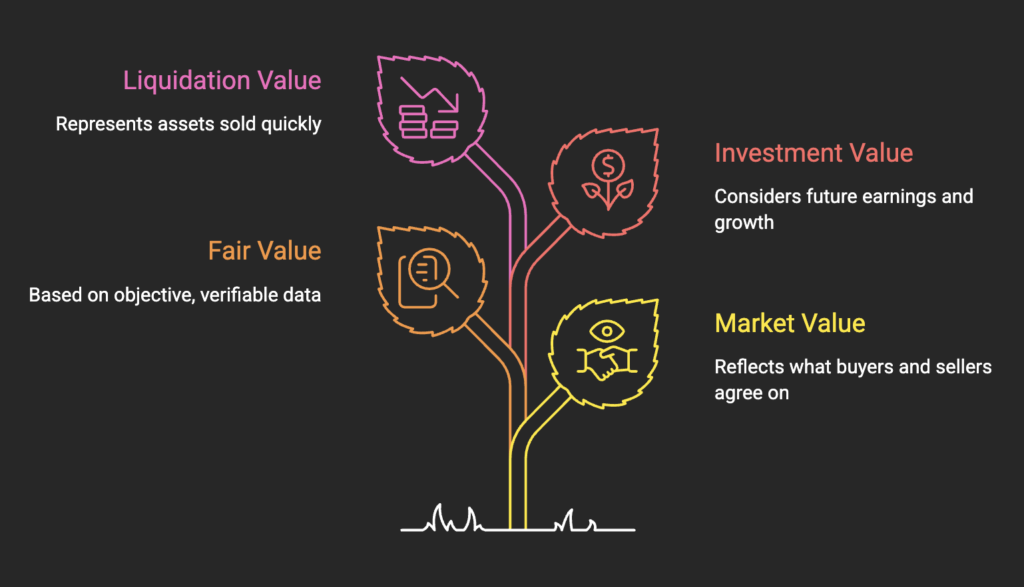
Business valuation is the process of estimating what a business, or a shareholding in it, is worth at a particular date and for a particular purpose. It is an evidence based opinion of value. It is not a guaranteed sale price, and it is not a single fixed number.
The purpose shapes everything that follows. A valuation prepared for a tax return, a divorce settlement and a trade sale can all produce different figures for the same company on the same day, without any of them being wrong.
Scale matters here. The Department for Business and Trade estimated 5.7 million private sector businesses in the UK at the start of 2025 in the 2025 Business Population Estimates, of which 99.85 per cent were small and medium sized enterprises. Almost all of them are privately held, illiquid and rarely traded.
By the end of this article you will understand what a valuation is, what governs it, who performs it, and why the answer is a range.
What business valuation actually means
A valuation answers a defined question. What would a defined interest in this business be worth, to a defined type of buyer, on a defined date, under a defined set of assumptions?
Change any of those four elements and the answer changes. A 100 per cent shareholding is not simply four times a 25 per cent shareholding, because control carries value and a minority position does not.
Business valuation is also distinct from accounting. Statutory accounts record historical cost and book value. Valuation looks forward, at the earnings and cash a buyer can reasonably expect to receive, and at the risk attached to receiving them.
What valuation is not is a prediction of the sale price. It is not a marketing figure. It is not a target. And it is not a warranty that any buyer exists at all.
If you want to understand how each approach is actually applied, the deeper resource is our guide on how to value a business, which sets out the individual methods and their mechanics.
Valuation is not the same as price
Value is an opinion formed under stated assumptions. Price is what one specific buyer actually paid, on the terms they actually agreed, at that moment.
The two rarely match, and the gap is not a mistake. Price is affected by deal structure, deferred consideration, earn outs, warranties, buyer synergies and how many other bidders were in the room.
A buyer who can strip out duplicate overheads may pay above the standalone value of your business. A buyer facing a distressed seller with a fixed deadline may pay well below it.
In practice, this is the point owners find hardest. We routinely see owners anchor to the top of a valuation range while buyers anchor to the bottom, and the negotiation happens in the space between.
The standards of value used in the UK
A standard of value is the definition of worth that the valuer is instructed to apply. It is the single most important assumption in any valuation, and it is usually dictated by the purpose rather than chosen freely.
The same business can be valued under several standards. Each produces a different figure. Confusing them is a common and expensive error.
Market value
Market value, sometimes called open market value in UK statute, is the price an asset might reasonably be expected to fetch on a sale in the open market. That definition is set out for capital gains purposes in section 272 of the Taxation of Chargeable Gains Act 1992, and an equivalent test applies for inheritance tax under section 160 of the Inheritance Tax Act 1984.
HMRC explains the statutory framework and the hypothetical sale it assumes in its guidance on the statutory open market basis. The buyer and seller are hypothetical, both willing, and neither is compelled to transact.
Americans call the same broad concept fair market value. In the UK the statutory language is open market value, and using the correct term matters when you are corresponding with HMRC.
Fair value
Fair value is a different animal. It is typically applied where shares change hands other than by an open market sale, for example under a shareholders agreement or a court ordered buy out.
Under fair value, discounts that would apply on the open market are often set aside. A minority discount, which is a reduction applied because a small shareholding cannot influence decisions, may be disallowed where the court considers the parties were effectively partners.
Investment value
Investment value is the worth of the business to one identified buyer, taking their specific circumstances into account. It reflects synergies, cost savings and strategic fit.
This is the standard that explains why a competitor may pay more than a financial investor. It is not the standard HMRC applies, because the statutory hypothetical buyer is nobody in particular.
Liquidation value
Liquidation value assumes the business stops trading and its assets are sold, either in an orderly process or a forced one. It usually sets the floor beneath any other figure.
It becomes relevant in insolvency, in solvent wind ups, and in loss making businesses where the assets are worth more than the trade. Goodwill, the value attaching to reputation, customer relationships and assembled workforce, generally disappears in a liquidation scenario.
Who carries out a business valuation in the UK
There is no single licence to value a business in the UK, and no protected title. What varies is the standard of evidence behind the opinion, and whether it will withstand challenge.
Business transfer agents and brokers usually provide an indicative price opinion. This is a market facing view of what a business might achieve in a sale, informed by transaction experience and current buyer appetite. It is not a formal valuation report.
Accountants and corporate finance advisers prepare valuations for shareholder transactions, share schemes and tax filings. Chartered valuation professionals prepare formal expert reports, including reports written to comply with court rules where an expert owes a duty to the court rather than to the party paying.
For tax matters, HMRC has its own specialist team. Shares and Assets Valuation values unquoted shares and other assets, and taxpayers can find the relevant process in HMRC’s guidance on shares and assets valuations for tax. The team’s role and structure are described in the Shares and Assets Valuation manual.
Choosing the wrong provider wastes money. A broker appraisal will not satisfy a tribunal, and a court compliant expert report is an expensive way to find out whether you should sell.
When a valuation is legally or commercially required
Some valuations are optional and commercial. Others are triggered by statute, and the figure you submit is open to challenge.
Tax and HMRC purposes
Inheritance tax and capital gains tax both require market value where a disposal is not at arm’s length, or where an asset passes on death. HMRC’s approach to substituting market value for actual proceeds is summarised in its guidance on capital gains market values.
Employee share schemes are a further trigger. A company granting options under an Enterprise Management Incentive scheme can ask HMRC to check its proposed valuation, and under the guidance on getting a share scheme valuation from HMRC an agreed EMI valuation is valid for 90 days from the date of agreement.
Shareholder and partnership changes
Articles of association and shareholders agreements usually set out how shares are valued when a shareholder leaves, dies or is removed. Read that clause before you commission anything.
Many agreements specify fair value and appoint an independent expert whose determination is final. The clause, not the market, then governs the outcome.
Disputes, divorce and insolvency
Minority shareholders who believe the company is being run against their interests can petition the court under section 994 of the Companies Act 2006. The usual remedy is a court ordered purchase of the petitioner’s shares, and valuation sits at the centre of the case.
Divorce proceedings frequently require a business to be valued as part of the matrimonial assets. Insolvency practitioners value businesses and their assets to compare a going concern sale against a break up, and to test whether creditors would be better off either way.
Sale, investment and succession
Commercial valuations underpin exit planning, raising investment, management buy outs and succession within a family. These are the valuations most owners actually commission.
Here the purpose is to inform a decision rather than satisfy a rule. The realistic output is a defensible range and a clear view of what would move the business up it.
What goes into a valuation
The starting point is three to five years of financial statements, plus current management accounts and a forward forecast. Historic accounts establish the trend; the forecast establishes the expectation.
The next step is normalisation. Normalised earnings are the profits the business would report under a new owner, once one off items, non trading costs, above market director remuneration and personal expenses are adjusted out. Adjusted EBITDA, meaning earnings before interest, tax, depreciation and amortisation after those adjustments, is the figure most buyers work from.
From that, the valuer distinguishes enterprise value, the value of the trading business itself, from equity value, which is what shareholders receive after debt is repaid and surplus cash is added back. Owners who confuse the two are often disappointed at completion.
Risk is then assessed. Customer concentration, contract length, sector regulation, supplier dependency, quality of management and market conditions all feed into the multiple or discount rate applied.
In our experience the first thing a buyer’s advisers challenge during due diligence is the add back schedule. Every adjustment to normalised earnings must be evidenced, not asserted.
Why valuation produces a range, not a number
Different methods produce different answers because they measure different things. An earnings based approach measures expected future returns. An asset based approach measures what is on the balance sheet. A market comparable approach measures what similar businesses have sold for.
A competent valuer runs more than one and looks for convergence. Where the approaches cluster, confidence rises. Where they diverge sharply, the divergence itself is the finding, and it usually points to a structural issue such as heavy fixed assets or weak earnings quality.
The output is therefore a range with a reasoned view on where within it the business sits. Anyone who gives you one precise number, with no assumptions stated, is selling you certainty they do not have.
Understanding why the methods disagree is worth the time. The mechanics of each approach, and how they interact, are set out in detail in our explanation of the methods used to value a UK business.
Why UK SME valuations differ from listed company valuations
A listed share can be sold in seconds at a published price. A shareholding in a private company cannot. That difference is called illiquidity, and it reduces value.
Valuers reflect it through a marketability discount, which is a reduction applied because the shareholding cannot be readily converted into cash. Minority holdings in private companies attract a further reduction for lack of control.
Owner dependency compounds the problem. If the customer relationships, technical knowledge and supplier terms live in the owner’s head, a buyer is acquiring a job rather than an asset. We have seen indicative offers revised downwards after a buyer meets the second tier of management and finds it thin.
Listed companies also publish audited, comparable data. SME accounts are prepared to minimise tax, not to present value, which is precisely why normalisation exists.
Common misconceptions about business valuation
The most common is that turnover determines value. It does not. Two businesses with identical revenue and different margins, contract quality and owner reliance are worth materially different sums.
The second is that industry rules of thumb are reliable. A multiple heard at a trade association dinner reflects a different business, in a different year, with a different capital structure.
The third is that a valuation guarantees a buyer. It does not. Value exists in theory; price requires a counterparty who wants what you have and can fund it.
The fourth is that the figure on the balance sheet is the answer. Net asset value ignores goodwill in a profitable trading business, and overstates worth in a loss making one.
What to do once you have a valuation
Read the assumptions before the number. Check the valuation date, the standard of value applied, the interest being valued and whether debt has been deducted.
Then treat the report as a diagnostic. It should tell you which factors are suppressing value, and most of those are fixable over twelve to twenty four months. Reducing customer concentration, documenting processes, tidying up the accounts and building a management layer beneath you all shift the range upwards.
If the valuation was commissioned for tax, court or share scheme purposes, take proper professional advice before you rely on it. This article is general information and not tax, legal or financial advice, and formal valuations for HMRC or court purposes require a suitably qualified professional whose report is prepared to the relevant standard.
If the valuation was commissioned to inform an exit, the next question is timing and readiness rather than price. A business that is well prepared attracts more bidders, and more bidders is what actually moves price.
Business valuation, properly understood, is a disciplined way of answering a specific question about worth. It will not tell you what a buyer will pay. It will tell you what your business is worth defending, where the weaknesses sit, and what a reasonable person would conclude on the evidence available today.

Author – John P. Gaskell
John is a senior member of the Blacks Brokers team with extensive experience leading successful national sales operations. He plays a central role in developing the team’s approach to client service, drawing on a deep belief that positivity, care and drive are the defining qualities of any great salesperson. John delivers comprehensive training across the organisation that instils a client-first ethos at every level, ensuring consistency of service throughout every transaction. His focus is always on achieving the best possible outcome for each client the business serves.

