- Open until 5pm
- 0333 370 0000
- 07507 247348

Passionate about selling your business.
Guide to the UK Business Transfer Process
Selling or acquiring a business is one of the most significant financial and operational decisions you will make. Whether you are a proprietor preparing your life’s work for handover, an entrepreneur evaluating acquisition opportunities, or an advisor supporting either party, understanding the UK business transfer process is essential to protecting your interests and ensuring a smooth transition.
A business transfer in the UK can take several forms. You might sell your assets (inventory, equipment, intellectual property, goodwill) whilst retaining the legal entity, or you might transfer ownership of the company itself through a share sale. You may even transfer a business undertaking as a going concern, which carries specific employment law implications. The process typically unfolds over three to six months, depending on the complexity of your business, industry regulation, employee numbers, and the diligence required by both parties.
This guide covers the statutory requirements, tax implications, and practical steps you need to follow. The guidance draws on official resources from Companies House, HMRC, GOV.UK, and Acas, ensuring that every step reflects current UK law and regulation.
Speak to one of our team
Enter your details and we’ll gladly get back to you.
Table of Contents
What is a UK Business Transfer?
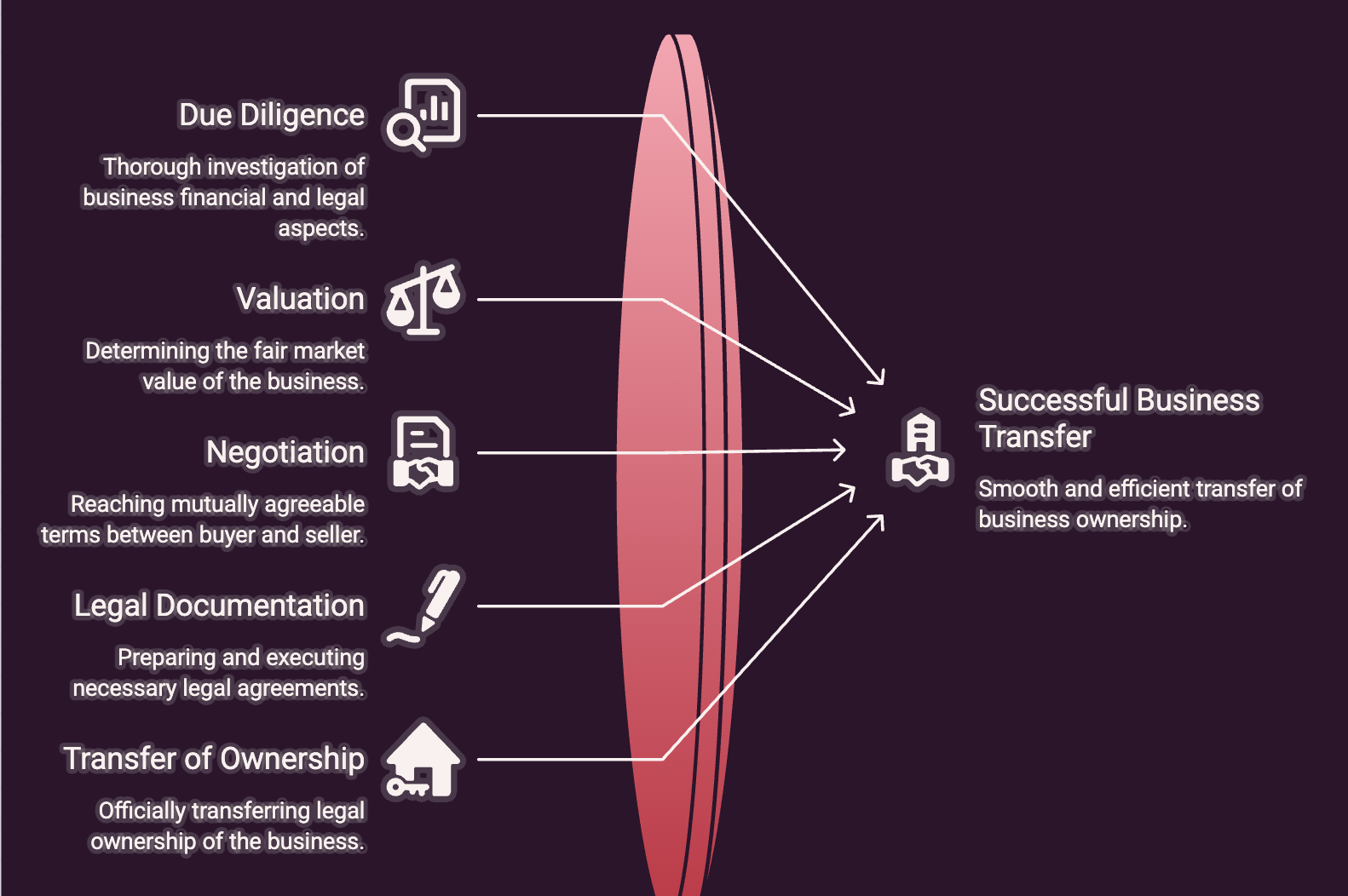
In legal and commercial terms, a UK business transfer is the process of moving ownership and operational control of a business from one party to another. This is distinct from simply selling physical assets or ending a trading relationship. A true business transfer means the buyer takes on ongoing operations, customer relationships, supplier contracts, and (usually) the existing workforce.
According to Companies House guidance on business transfers, the term encompasses several structures. An asset transfer involves the sale of specific assets (stock, equipment, premises, brand), while a share transfer involves the sale of company shares, transferring ownership of the legal entity itself. A business undertaking transfer (often used under the Transfer of Undertakings Protection of Employment Regulations 2006, commonly called TUPE) occurs when a business or part of a business is transferred as a going concern, triggering automatic employment protections.
The distinction matters because each structure has different implications for tax, liability, and employment rights. The buyer’s perspective differs from the seller’s perspective on each option. Some buyers prefer asset purchases because they avoid inheriting hidden liabilities; other buyers prefer share sales because they retain existing contracts and customer relationships without needing to renegotiate. Sellers, conversely, may prefer share sales for tax efficiency, or asset sales to compartmentalise what they are selling.
TUPE regulations add another layer of complexity. If you transfer a business undertaking, employee rights transfer automatically to the new owner regardless of what the sale contract says. This means the buyer becomes the legal employer and assumes pension obligations, accrued holiday pay liability, and any future claims relating to that employment period. Understanding TUPE early is crucial to both parties. Further detail on how TUPE applies to your sale is covered in our guide to TUPE Regulations in Business Transfers: What Sellers and Buyers Must Know.
The broader context is one of commercial autonomy within legal guardrails. The UK Government recognises business transfers as a key component of entrepreneurship, workplace continuity, and economic activity. However, employee protections, tax fairness, and regulatory compliance create a framework within which every transfer must operate.
Key Regulatory and Legal Framework
The legal and regulatory environment for business transfers spans multiple statutes and regulatory bodies. Understanding this framework helps you navigate the process without unnecessary surprises.
The primary statute is the Companies Act 2006, which sets out rules for the formation, administration, and dissolution of limited companies. When you transfer shares, you are following procedures outlined in the Companies Act. Directors have duties (under sections 170-177 of the Act) to act with care and diligence and to avoid conflicts of interest, even during a sale process. Companies House publishes detailed guidance on the Companies Act 2006, including requirements for share transfer documentation, director sign-off, and registration of changes in ownership.
The Transfer of Undertakings Protection of Employment Regulations 2006 (TUPE) is equally critical if you employ staff. TUPE is a statutory instrument that protects employees’ rights when a business transfers. According to Acas guidance on TUPE, if you transfer a business as a going concern, all contracts of employment transfer automatically to the new owner. Employees cannot be dismissed merely because of the transfer, and their terms and conditions cannot be worsened. This carries significant liability for both seller and buyer if not handled correctly.
VAT recovery and transfer rules are administered by HMRC. The treatment of VAT in a business transfer depends on whether you sell assets or shares. HMRC guidance on VAT and business transfers clarifies that a transfer of a business as a going concern may be treated as a supply of services (not subject to VAT) if certain conditions are met. This can substantially reduce the cost of transfer for the buyer, but the seller must comply with strict notification requirements. Failure to correctly apply VAT rules can result in assessments, penalties, and cash-flow problems.
Employment law extends beyond TUPE. Statutory redundancy payments, holiday pay accrual, and pension obligations all fall under the remit of the Employment Rights Act 1996. If you are the seller, you must ensure all statutory liabilities are met before completion, or the buyer may pursue you for breach of warranty. Acas provides comprehensive guidance on employment law in business transfers.
Stamp duty and inheritance tax may also be relevant, though full tax planning is covered in a later section. Stamp Duty Land Tax (SDLT) applies if property is part of the transfer; Stamp Duty Reserve Tax (SDRT) applies to share transfers depending on the structure. HMRC guidance on stamp duty clarifies the rates and exemptions that may apply to your specific transfer.
For a complete exploration of the legal obligations, statutory consultation requirements under TUPE, and sector-specific regulatory approval, see our guide to TUPE Regulations in Business Transfers: What Sellers and Buyers Must Know.
Ready to take the next step?
Contact our team of experienced business sale professionals to discuss your specific situation and explore how we can help you achieve your business sale objectives.
Types of Business Transfer
The two primary structures for a business transfer are the asset sale and the share sale. Each has distinct legal, tax, and operational consequences.
Asset Sale Structure
In an asset sale, the buyer purchases specific assets: inventory, equipment, intellectual property, customer contracts, brand name, goodwill, and (optionally) premises. The seller retains legal ownership of the company itself. The company’s bank accounts, existing debts, tax liabilities, and employment contracts remain with the seller (unless the buyer agrees to assume them).
From the buyer’s perspective, an asset sale offers protection. The buyer does not inherit unknown liabilities, historical tax disputes, or legacy employment claims. However, the buyer must renegotiate customer and supplier contracts because the counterparty to the original contract (the selling company) no longer operates the business. This can be time-consuming and risky if key customers or suppliers refuse to contract with the new owner.
From the seller’s perspective, an asset sale triggers capital gains tax on the profit made on each asset sold. If your goodwill is valued at GBP 500,000 and you sell it for GBP 500,000, you will owe capital gains tax on this gain (at the rate applicable to you as an individual or company). The selling company may also owe corporation tax on the gain. After the sale, you are left with a company that owns cash but carries any remaining liabilities; you must then distribute this cash to shareholders or place it into a personal pension (if using a personal company and qualifying for pension relief).
Asset sales are common where the buyer wants to cherry-pick assets, avoid liability exposure, or renegotiate major contracts on more favourable terms. They are less common where the business relies on long-term customer relationships or regulatory approvals that cannot be easily transferred.
Share Sale Structure
In a share sale, the buyer purchases shares in the company itself. The buyer becomes the owner of the legal entity and assumes all assets, liabilities, contracts, and obligations. Employees transfer under TUPE automatically. The company’s bank accounts, customer contracts, and supplier relationships all pass to the new owner without renegotiation (unless a contract includes a change-of-control clause).
From the buyer’s perspective, a share sale simplifies administrative handover. There is no need to renegotiate contracts or reorganise operations. However, the buyer inherits all liabilities: any tax dispute HMRC may later pursue, environmental liability, employment claims, or warranty breach claims by customers.
From the seller’s perspective, a share sale is typically more tax-efficient if structured correctly. Rather than paying capital gains tax on individual assets, you pay capital gains tax on the shares you sell. If you have owned the shares for several years and they are in a trading company, you may qualify for Entrepreneurs’ Relief (now known as Business Asset Disposal Relief under HMRC rules), which can reduce your capital gains tax rate significantly. HMRC guidance on Business Asset Disposal Relief sets out detailed eligibility criteria, including that the company must be a trading company (not primarily a property investment business) and you must own at least 5 percent of the shares for at least one year before disposal.
A share sale also avoids SDRT and SDLT on individual assets, though Stamp Duty Reserve Tax may apply to the share transfer itself at a lower rate in many cases.
Pros and Cons Comparison
The following table summarises the key advantages and disadvantages of each structure for both buyer and seller:
Asset Sale
- Buyer Advantages: Avoids inheriting liabilities; can choose which assets to purchase; may acquire assets at a discount if seller needs liquidity.
- Buyer Disadvantages: Must renegotiate customer and supplier contracts; no automatic transfer of employee relationships; brand reputation and customer goodwill do not automatically transfer.
- Seller Advantages: Can retain the legal company and any non-transferred assets; may avoid TUPE consultation if structured carefully; can offload liabilities not sold.
- Seller Disadvantages: Triggers capital gains tax on each asset; typically results in higher total tax than a share sale if relief is available; may be more complex from a commercial perspective if the buyer only wants certain assets.
Share Sale
- Buyer Advantages: Existing contracts and customer relationships transfer automatically; TUPE applies, so no need to renegotiate employment terms; simplified administrative handover.
- Buyer Disadvantages: Inherits all liabilities (visible and hidden); assumes any tax or employment disputes; limited ability to “cherry-pick” value.
- Seller Advantages: Typically more tax-efficient (particularly if Business Asset Disposal Relief is available); avoids the complexity of dividing assets; receives a single payment for the entire business.
- Seller Disadvantages: The buyer will conduct extensive due diligence to identify liabilities; may require warranties and indemnities to protect the buyer if issues arise after completion; may need to pay escrow or holdback amounts pending resolution of any claims.
For a detailed breakdown of the tax and legal implications of each structure, including calculation worked examples and relief eligibility, see our guide to Asset vs Share Transfer: UK Tax and Legal Implications.
The Business Transfer Process: Step-by-Step
A business transfer, whether asset or share sale, follows a predictable six-phase process. Understanding each phase helps you plan timelines, manage risk, and co-ordinate advisors.
Phase 1: Preparation and Planning
Before approaching potential buyers or sellers, conduct a thorough financial and legal audit of the business. If you are selling, ensure all financial records are accurate and up to date. This includes management accounts, tax returns, statutory accounts, VAT returns, and PAYE records. Buyers and their advisors will scrutinise these documents carefully.
Simultaneously, conduct a business valuation. This establishes the asking price (if you are selling) or the offer ceiling (if you are buying). Valuation methods include comparable company analysis (comparing your business to similar enterprises that have recently sold), earnings multiple methods (applying a standard multiple to your EBIT or net profit), and discounted cash flow analysis (projecting future profits and discounting them to present value). Each method has strengths and weaknesses depending on your industry. For detailed guidance on valuation methods recognised by HMRC and used in UK business transfers, see our guide to Valuing a UK Business: 5 Methods HMRC Recognises.
If you are selling, also prepare a business information memorandum (IM). This is a confidential document that introduces potential buyers to your business without revealing commercially sensitive information too early. A typical IM covers company history, market position, products or services, customer and supplier base (usually anonymised), financial performance over the past three to five years, management team, and any key risks or opportunities. The IM is used to attract serious buyers and filter out those without the financial capacity or strategic interest to proceed.
Finally, identify and engage your professional advisors early. If you are selling, a tax advisor and solicitor should review your records and flag any issues (outstanding tax assessments, compliance gaps, contractual problems) before you market the business. Addressing these proactively strengthens your negotiating position and accelerates the process later.
Phase 2: Finding a Buyer or Seller
If you are selling, you have two main routes: using a professional business broker or marketing directly.
A business broker maintains networks of potential buyers and handles the confidential approach to prospects. The broker will manage initial conversations, filter buyers by financial capacity and strategic fit, and handle the information memorandum process. Brokers typically charge a success fee (a percentage of the sale price, often 5-10 percent of the deal value for smaller businesses) and may charge an upfront retainer. The advantage is speed, confidentiality, and professional handling of negotiations. The disadvantage is cost and potential loss of control over the narrative.
A direct sale (without a broker) means you approach buyers yourself, publicise the sale, or work through your professional network. This saves broker fees but requires time and exposes your sale to the market, which may affect customer and employee confidence, or alert competitors. Most business owners use a combination: they engage a broker but also pursue strategic buyers they know directly.
If you are a buyer, you are likely either seeking out businesses matching your investment criteria or responding to an available business being marketed. Due diligence begins at this stage: is this a business worth pursuing? Does it fit your strategic plans? Can you afford it?
Confidentiality is critical at this stage. Both buyer and seller typically sign a Non-Disclosure Agreement (NDA) before detailed financial information is shared. The NDA protects the seller’s confidential information and ensures the buyer does not use the information to compete or inform other negotiations.
Phase 3: Due Diligence
Due diligence is the process by which a buyer (and their advisors) investigates the business to verify claims, identify risks, and quantify liabilities.
Financial due diligence covers audited or reviewed accounts, management accounts, VAT returns, payroll records, tax assessments, and cash flow. The buyer’s accountant will verify that revenues are genuine, cost structures are accurate, and no hidden losses or liabilities exist.
Legal due diligence involves reviewing all significant contracts (customer agreements, supplier agreements, loan facilities, lease agreements), employment contracts, intellectual property ownership, regulatory approvals (if applicable), and any litigation or disputes. The buyer’s solicitor will check that contracts do not contain change-of-control clauses that would terminate on sale (e.g., some major customer contracts require consent from the customer before a change in ownership).
Tax due diligence examines any HMRC correspondence, tax disputes, VAT position, and outstanding tax liabilities. If the business has a complex tax structure, the buyer’s tax advisor will review it carefully.
Employment due diligence checks the accuracy of statutory returns (PAYE, National Insurance), any grievances or disciplinary matters, accrued holiday pay, pension obligations, and TUPE compliance. If the business is sold as a going concern, the buyer must understand exactly which employees transfer and on what terms.
Operational due diligence examines customer concentration (is 50 percent of revenue from one customer?), supplier dependencies, asset condition, stock levels, and any legal or regulatory compliance issues.
As the seller, you will be required to complete a disclosure questionnaire (a lengthy document asking you to confirm the accuracy of statements about the business) and to provide documentation supporting your answers. Answering truthfully and comprehensively is essential; misstatements can give rise to breach of warranty claims after completion.
For a comprehensive checklist of due diligence items, see our guide to Business Transfer Due Diligence Checklist for UK Sales.
Phase 4: Legal and Financial Structuring
Once due diligence progresses and the buyer is satisfied with the business, the parties enter formal negotiation over price and structure.
The buyer’s tax advisor will recommend whether an asset or share sale is preferable. An asset sale may save the buyer taxes if they can increase the depreciation base of tangible assets. A share sale may be preferable if the business has valuable contracts that would be difficult to renegotiate or if the cost of restructuring is prohibitive.
The seller’s tax advisor will model both scenarios to understand the after-tax proceeds. A share sale often emerges as more tax-efficient, particularly if Business Asset Disposal Relief applies. However, the buyer’s requirement for indemnities and escrow may erode this advantage.
Advisors will also consider structuring options such as an earn-out (where part of the purchase price is contingent on post-completion performance), a management holdback (where key management agree to stay for a period post-completion), or a deferred payment arrangement. These structures can influence tax treatment and are often used to bridge a valuation gap between buyer and seller.
For an in-depth exploration of tax planning strategies specific to asset and share sales, see our guide to Tax Planning for UK Business Sales: CGT, Corporation Tax and VAT.
Phase 5: Documentation and Completion
Once price and structure are agreed, the parties’ solicitors draft the key documents:
The Share Purchase Agreement (SPA) or Asset Purchase Agreement (APA) is the main contract. It sets out the assets or shares being sold, the purchase price, payment terms, representations and warranties, indemnities (promises to cover specific liabilities), and conditions precedent (i.e., matters that must be satisfied before completion, such as regulatory approval or third-party consent).
Representations and warranties are statements of fact made by the seller regarding the business. These typically cover company incorporation, ownership of assets, title to intellectual property, absence of litigation, accuracy of financial records, compliance with tax obligations, and employee matters. If a representation proves false after completion, the buyer can claim an indemnity (compensation) from the seller.
Indemnities go beyond representations. For example, an indemnity might state that if an HMRC tax assessment is raised relating to a period before completion, the seller will reimburse the buyer. Indemnities are often time-limited (e.g., lasting two years post-completion) and capped at a certain amount.
An escrow or holdback arrangement is common to protect the buyer. The buyer retains a percentage of the purchase price (typically 10 percent) in an escrow account for a period (typically 18 months). If warranty claims arise, the buyer can claim from the escrow. If no claims arise by the deadline, the escrow is released to the seller.
Regulatory approvals, if required by the business’s sector (e.g., financial services, healthcare), must be obtained before or on completion.
On completion day, the following occurs in sequence: funds are transferred from the buyer to the seller (or to an escrow agent), legal title to the assets or shares is transferred, statutory documents are filed (if a share sale), and the parties execute all closing documents. For an asset sale, the buyer should also notify material customers and suppliers of the change in ownership and request confirmation that they will continue to trade.
Phase 6: Post-Completion
After completion, several administrative and compliance tasks must be handled promptly.
The seller must file confirmation of the share sale with Companies House (if applicable) and notify HMRC of the change in ownership. The seller’s accountant will then prepare final accounts for the selling company (if it remains in existence) and file a final tax return with HMRC covering the post-completion period.
The buyer must register the change in company ownership with Companies House (if a share sale) or register the new business details with HMRC (if an asset sale). If employees have transferred under TUPE, the buyer must complete TUPE consultation formalities that may not have been finalised before completion (though consultation should begin before completion).
Tax-related tasks include registering for PAYE if the buyer did not previously employ staff, updating VAT registration if the business was purchased as a VAT-registered entity, and ensuring all outstanding National Insurance contributions are paid.
The buyer’s accountant will reconcile any working capital adjustments (the agreement may require adjustment if the business had more or less cash or inventory at completion than anticipated) and prepare post-completion tax returns.
Ready to take the next step?
Contact our team of experienced business sale professionals to discuss your specific situation and explore how we can help you achieve your business sale objectives.
TUPE Regulations and Employee Transfers
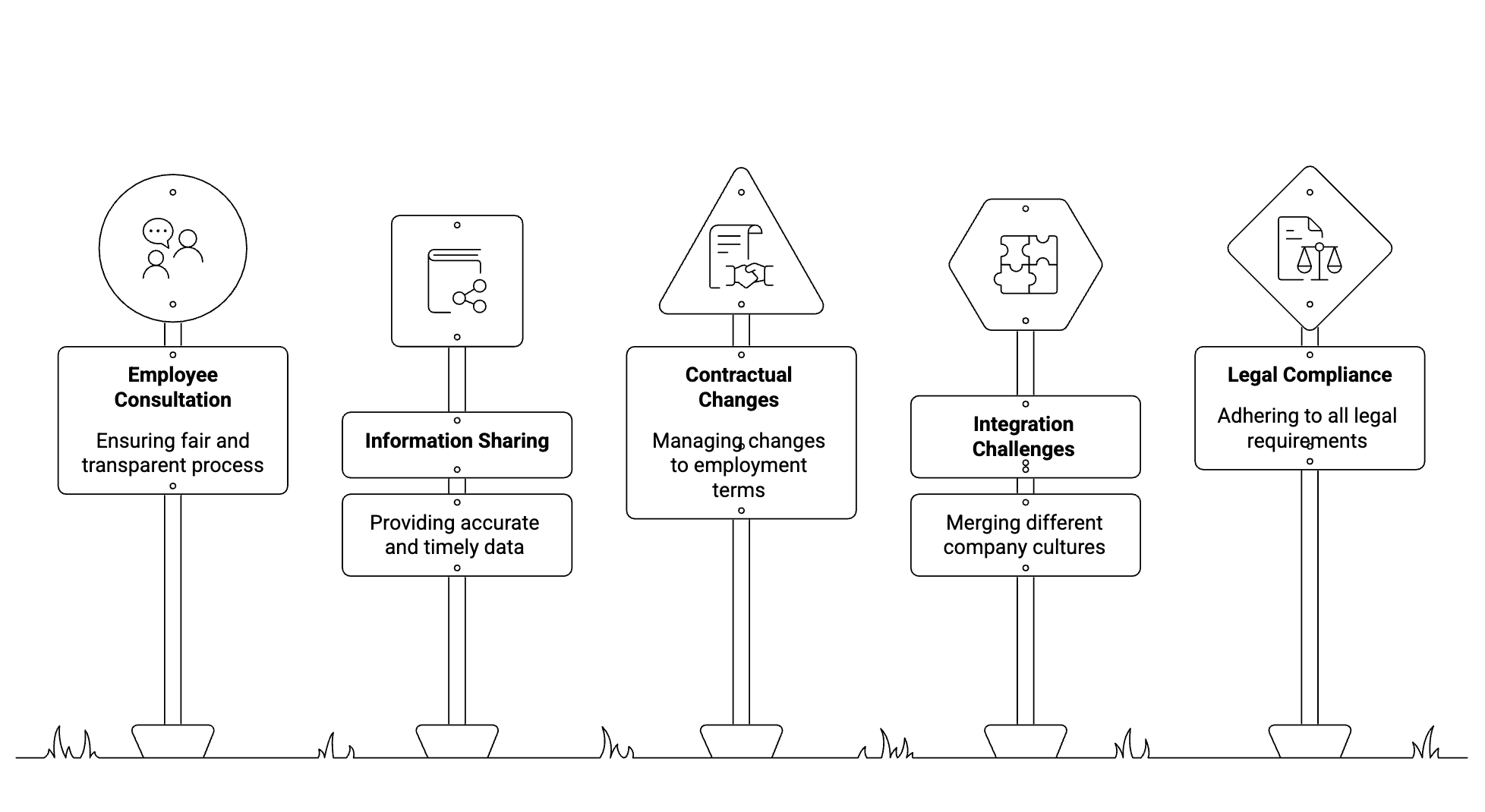
The Transfer of Undertakings Protection of Employment Regulations 2006 applies whenever a business (or a distinct part of a business) transfers as a going concern. Understanding TUPE is essential for both seller and buyer.
What TUPE Means
According to Acas guidance on TUPE, when a business transfers, all contracts of employment automatically transfer to the new owner (the buyer). The employees become the employees of the buyer on the same terms and conditions they had with the original employer (the seller). This is automatic by law; the employer cannot contract out of it.
Crucially, TUPE applies whether or not the contract of sale mentions employee transfer and regardless of what the buyer and seller agree privately. The law overrides the contract. If a business has ten employees and the contract states “the buyer purchases only the business assets and excludes employees,” TUPE still applies, and the buyer becomes the employer of all ten employees.
TUPE also applies even if the sale is technically an asset sale in legal form. If the buyer acquires the assets and continues to operate the same business, TUPE may still apply if the business is transferred as a going concern. This is determined by looking at the economic substance of the transaction, not the legal label.
TUPE Consultation Requirements
Before a TUPE transfer, there is a legal duty to consult affected employees (and their representatives, if they are unionised or have elected representatives). According to Acas, the seller must:
- Inform employees of the transfer at the earliest opportunity
- Provide reasons for the transfer
- Inform employees of the legal, economic, and social consequences
- Discuss any measures the employer will take in relation to the transfer (e.g., harmonising pay, relocating jobs, or making redundancies)
- Invite employees (or their representatives) to comment
Consultation must be “in good time before the transfer takes effect” (typically at least 14 days before, though case law suggests this should be longer if complex measures are planned). Failure to consult can result in claims by individual employees for breach of contract or constructive unfair dismissal.
The buyer (the new employer) should also consult employees from the point of completion. The buyer must inform the employees of any changes planned to their terms and conditions and discuss any redundancies or restructuring.
Automatic Transfer of Liabilities
When TUPE applies, all employment liabilities transfer to the buyer. This includes accrued holiday pay (an employee who has earned 20 days of holiday but taken only 15 days has a liability of 5 days owed by the seller, but the buyer must account for this), statutory redundancy entitlements, and any unfair dismissal or discrimination claims relating to periods before completion.
This is a significant issue. If an employee has a potential claim for discrimination but has not yet brought a claim at the point of transfer, the buyer (the new employer) may inherit that liability. Similarly, if the seller made an employee redundant shortly before the transfer with insufficient notice, the buyer might inherit the employment tribunal claim.
Exceptions to TUPE
TUPE does not apply in a small number of circumstances. If the business is insolvent and subject to an insolvency procedure (administration, liquidation, or receivership), TUPE may not apply, or its application may be modified. The Insolvency Service provides detailed guidance on this.
TUPE also does not apply if the business is sold by a private individual (not in the course of a business). For example, if you retire and sell your sole-trader business, TUPE may not apply. However, this is a narrow exception and is fact-dependent.
Practical Implications for Seller and Buyer
For the seller, TUPE consultation and notification of liabilities are time-consuming but necessary. Failing to consult properly exposes you to claims after completion. It is advisable to engage advisors (HR consultants or employment lawyers) early to ensure proper process.
For the buyer, TUPE means you must budget for potential employment liabilities and ensure your financial projections account for them. You should conduct thorough employment due diligence to identify any historic claims, grievances, or compliance issues.
For a comprehensive guide to TUPE obligations, consultation requirements, and strategies for managing liabilities, see our guide to TUPE Regulations in Business Transfers: What Sellers and Buyers Must Know.
Tax Considerations and Planning
Tax is often the largest variable in a business transfer. The difference between an ad-hoc approach and a structured tax plan can run to tens of thousands of pounds.
Capital Gains Tax (Seller)
If you are an individual and you sell a business, you will typically owe capital gains tax on the gain (sale price less cost base). The cost base is usually the original purchase price plus any improvements, less any capital allowances claimed.
Capital gains tax is charged at 10 percent (for basic-rate taxpayers) or 20 percent (for higher-rate taxpayers) on gains above an annual exemption (GBP 3,000 in the 2024/25 tax year, though this is subject to change; check HMRC rates and allowances for the current year).
If your business qualifies, you may claim Business Asset Disposal Relief (formerly Entrepreneurs’ Relief). This relief reduces the capital gains tax rate to 10 percent for all gains up to a lifetime limit of GBP 1 million. To qualify, the business must be a trading business (not primarily investment-based), you must own at least 5 percent of the shares, and you must have owned the shares for at least one year. If you have owned your business for ten years, and it qualifies, relief could save you GBP 100,000 in tax on a GBP 1 million gain (at a top rate of 20 percent without relief).
If you are a company (e.g., you hold the business through a limited company), the company will owe corporation tax on the gain (19 percent as of 2023/24, though this may increase; check HMRC for current rates). You can then pay dividends from the after-tax proceeds, triggering dividend tax in your hands, creating a double tax effect.
For detailed worked examples and strategies to minimise capital gains tax exposure, see our guide to Tax Planning for UK Business Sales: CGT, Corporation Tax and VAT.
Corporation Tax (Both Parties)
If the selling business is a limited company, the company will owe corporation tax on the gain from the sale. If the business is a sole trader or partnership, income tax (not corporation tax) applies to the sale of business assets, but the principles are similar.
If you are a buyer acquiring an asset, you may be able to claim capital allowances on tangible assets (equipment, vehicles, machinery). This reduces your taxable profit in subsequent years and should be factored into your financial model for the acquisition.
Stamp Duty and Stamp Duty Land Tax
Stamp duty (now officially called the Stamp Duty Reserve Tax) applies to the transfer of shares at a rate of 0.5 percent of the share price. So a share purchase of GBP 1 million attracts GBP 5,000 in stamp duty. HMRC provides detailed guidance on stamp duty and business transfers.
Stamp Duty Land Tax (SDLT) applies if land or buildings are part of the asset transfer. SDLT rates range from 0 percent (on transfers below GBP 250,000) to 15 percent (on residential property purchases by non-UK residents or large corporate buyers). If your business operates from leased premises (not owned), SDLT does not apply. If you own the building and include it in the asset sale, SDLT will be charged.
VAT Recovery and Transfer Rules
VAT treatment in business transfers is complex and depends on whether the sale qualifies as a transfer of a business as a going concern. According to HMRC VAT guidance, if the business qualifies as a going concern transfer, the supply is treated as a supply of services (not subject to VAT). This is valuable because the buyer does not pay VAT on the purchase price.
To qualify, the business must be transferred as a functioning unit capable of continuing independently, and the buyer must take over the business as an operating entity. Partial transfers and the sale of discrete assets typically do not qualify.
If the sale does not qualify as a going concern transfer, VAT is charged at the standard rate (20 percent) on assets. This increases the buyer’s cost significantly and may affect the deal economics.
HMRC has detailed rules on VAT treatment of business transfers, and professional advice is essential to ensure the sale is structured correctly and claims for relief are valid.
Holdback and Escrow Tax Implications
If part of the purchase price is held in escrow or subject to an earn-out, the tax treatment must be considered. For the buyer, the amount held back is still treated as part of the cost base for capital allowances purposes. For the seller, tax may be charged immediately on the full amount (even if part is held in escrow) or deferred until the holdback is released, depending on the structure and whether the holdback amount is genuinely contingent on uncertain future events.
Professional advice from a tax advisor experienced in M&A is essential to structure holdbacks correctly.
Post-Completion Tax Planning
After completion, both parties have ongoing tax obligations and planning opportunities. The seller must file a final tax return and deal with any revenue enquiries into pre-completion tax matters. The buyer must ensure the business is registered for all relevant taxes and that future tax planning (such as utilising losses or claiming capital allowances) is optimised.
For comprehensive worked examples and strategies specific to different business structures and ownership scenarios, see our guide to Tax Planning for UK Business Sales: CGT, Corporation Tax and VAT.
Professional Advisors You'll Need
A business transfer is too complex for most sellers and buyers to navigate alone. You will need a team of professional advisors.
Tax Advisor or Accountant
A tax advisor with M&A experience is essential for both seller and buyer. For the seller, the advisor models different sale structures, calculates tax liability, identifies reliefs available, and assists with tax compliance post-completion. For the buyer, the advisor evaluates the tax treatment of the business structure being acquired, checks for any embedded tax risks, and plans post-acquisition tax strategy (e.g., capital allowances, loss utilisation, transfer pricing if part of a larger group).
Costs: A tax advisor for a seller typically charges between GBP 2,000 and GBP 10,000 depending on complexity. For larger transactions (multi-million pound deals), costs can be higher if substantial modelling or HMRC correspondence is required.
Solicitor
A solicitor handles all legal documentation (share or asset purchase agreements, representations and warranties, indemnities, escrow agreements, non-disclosure agreements). The solicitor conducts legal due diligence, reviews contracts, identifies risks, and ensures compliance with statutory requirements (such as Companies House filings and regulatory approvals). The solicitor also handles post-completion formalities.
For a seller, the solicitor protects your interests by negotiating terms, limiting exposure in warranties and indemnities, and ensuring you understand the implications of every clause. For a buyer, the solicitor ensures the contract is comprehensive and that key commercial assumptions are contractually protected.
Costs: Solicitor costs for a business transfer typically range from GBP 5,000 to GBP 25,000 depending on transaction complexity and value. Small transactions may be at the lower end; acquisitions involving regulatory approval or complex employment issues will cost more.
Business Broker
If you are selling, a business broker may help identify buyers and manage the sales process. Brokers maintain networks and can often attract serious buyers more quickly than a direct approach. However, brokers typically charge a success fee (typically 5-10 percent of the deal value for businesses valued under GBP 5 million).
Brokers are not necessary for all sales. Some owners prefer to market directly to strategic buyers or work through their professional network. The decision depends on your industry, business profile, and how quickly you want to complete a sale.
Business Valuer
An independent valuation by a qualified professional is valuable for both seller and buyer. The valuation provides an objective basis for negotiation and protects you against accusations of unfair pricing (which could trigger scrutiny by HMRC, particularly if you later claim a loss for tax purposes). A valuer should be qualified by a professional body such as the Royal Institution of Chartered Surveyors (RICS) for asset valuations or the Chartered Institute of Valuers (CIV) or Institute of Business Valuers (IBV) for business valuations.
Costs: A business valuation typically costs between GBP 1,500 and GBP 10,000 depending on the business’s complexity and size.
Company Secretary or Compliance Advisor
If the business is a limited company, a company secretary ensures statutory compliance throughout the transfer process. This includes ensuring directors’ duties are met, preparing directors’ resolutions to approve the sale, maintaining statutory registers, and filing documents with Companies House.
Insurance Broker
After completion, you may need professional indemnity insurance, employer’s liability insurance, or public liability insurance. An insurance broker can advise on appropriate cover and manage the transfer of insurance policies from seller to buyer.
For a detailed guide to selecting advisors, managing advisor relationships, and understanding the scope of each advisor’s role, see our guide to Choosing Advisors for a UK Business Transfer: Roles and Costs.
Timeline, Costs and Common Pitfalls
Typical Timeline
A business transfer typically takes three to six months from first contact with a potential buyer or seller to completion. This timeline varies depending on business complexity, due diligence scope, and how quickly parties can agree on terms.
A simplified timeline for a typical transfer:
- Weeks 1-3: Business preparation, valuation, engagement of advisors.
- Weeks 4-8: Marketing the business (if selling) or identifying acquisition targets (if buying); initial conversations and signing of NDA by interested parties.Weeks 9-12: Due diligence; management of buyer questions and information requests.
- Weeks 13-16: Agreement on price and key commercial terms; drafting of purchase agreement by solicitors.
- Weeks 17-20: Negotiation of final contract terms; resolution of due diligence issues; obtaining regulatory approvals if required.
- Weeks 21-26: Final preparation; TUPE consultation (if applicable); tax planning finalisation; completion.
Factors that extend timelines include regulatory delays (particularly in financial services or healthcare sectors where approvals can take months), complex due diligence findings that require investigation or remediation, disagreement between buyer and seller on warranties and indemnities, or TUPE consultation complications if the business has unions or complex employment issues.
Cost Breakdown
Professional fees are typically the largest post-transaction cost. For a GBP 1 million business transfer with an asset sale structure and a team of advisors, you might expect:
Tax advisor fees: GBP 3,000 to GBP 8,000.
Solicitor fees: GBP 7,000 to GBP 15,000.
Business broker (if used): 5-10 percent of sale price (GBP 50,000 to GBP 100,000 for a GBP 1 million deal).
Business valuation: GBP 2,000 to GBP 5,000.
Accountant for post-completion compliance: GBP 1,500 to GBP 3,000.
For a GBP 5 million deal with share sale structure and regulatory complexity, total advisor costs might reach GBP 100,000 to GBP 200,000, representing 2-4 percent of deal value.
These costs are largely tax-deductible for the seller (reducing your net proceeds) and must be factored into the buyer’s acquisition cost.
Common Pitfalls
Seller Pitfalls
Incomplete financial records cause significant delays during due diligence. Buyers and their advisors will scrutinise every entry in your accounts. Ensure management accounts are accurate and reconcile to your statutory accounts.
Poor preparation on employee matters triggers TUPE delays and risks post-completion claims. Conduct an employment audit early: verify that all staff are properly paid, that National Insurance is up to date, and that any grievances or disputes are resolved or clearly documented.
Failing to disclose known issues in the business can expose you to breach of warranty claims after completion. Conversely, over-disclosing minor issues can scare off buyers. Work with your advisor to strike the right balance: material issues must be disclosed; trivial matters need not be.
Underestimating tax liabilities can mean a significant portion of your sale proceeds go to HMRC. Model your tax liability early, explore reliefs with a tax advisor, and structure the deal to minimise your tax burden.
Buyer Pitfalls
Insufficient due diligence into customer concentration can be costly. If the business relies on a handful of large customers and due diligence does not verify that these customers will continue to trade with the buyer post-completion, the business’s value may evaporate.
Underestimating TUPE liabilities is common. Many buyers do not fully account for accrued holiday pay, pension contributions, or potential employment claims that transfer automatically. Employ an HR consultant to conduct thorough employment due diligence.
Failing to verify contracts have no change-of-control clauses can result in loss of major customer or supplier relationships immediately post-completion. Review all material contracts during legal due diligence; check that no consent or notice is required on change of ownership.
Inadequate tax due diligence can result in unexpected tax liabilities post-completion. Ensure the seller’s tax position is clean: no outstanding assessments, no VAT disputes, no transfer pricing issues (if applicable).
Rushing to completion without resolving all due diligence issues can result in purchasing a business that does not match the seller’s representations. Take time to resolve issues before completion; negotiate indemnities carefully to ensure you have recourse if issues emerge post-completion.
Sector-Specific Considerations
Some sectors have additional regulatory requirements for business transfers.
Financial Services
If your business is regulated by the Financial Conduct Authority (FCA), the transfer may require FCA approval. This applies to investment firms, insurance brokers, and certain payment service providers. The FCA must be notified of the change in ownership, and approval may take several weeks. Failure to obtain approval before completion could result in the business operating without proper authorisation, triggering fines and enforcement action.
FCA guidance on changes in control provides detailed requirements and timelines.
Healthcare and Social Care
If your business is a care home, dental practice, or other healthcare provider, you may need approval from the relevant regulator (the Care Quality Commission for care services, the General Dental Council for dental practices). These approvals can take several months and may require evidence of the buyer’s suitability.
Legal Services
Law firms must comply with the Solicitors Regulation Authority (SRA) rules on ownership and management. The SRA may need to be notified of a change in control, and approval may be required depending on the structure of the transfer.
Companies with Environmental Liability
If your business operates in a sector with environmental risk (manufacturing, waste management, energy production), the buyer may inherit environmental liabilities. Environmental due diligence is essential, and you may need environmental insurance or indemnities to protect the buyer.
For a comprehensive guide to sector-specific requirements and regulatory approval timelines, see our guide to Business Transfer in Regulated Industries: UK Requirements.
Ready to take the next step?
Contact our team of experienced business sale professionals to discuss your specific situation and explore how we can help you achieve your business sale objectives.
Frequently Asked Questions
A typical business transfer takes three to six months from initial contact with a buyer or seller to completion. This assumes straightforward due diligence and no unusual complications. Complex businesses with regulatory requirements or significant employment issues may take six to twelve months. The main variables are the speed at which the parties can agree on price and terms, the complexity of due diligence, and any regulatory approvals required.
No. You can sell directly to a buyer without using a broker. Direct sales save broker fees but require more time and effort on your part to identify and approach potential buyers, and may expose the sale to the market (risking customer and employee concerns). Many sellers use a hybrid approach: they engage a broker for professional handling but also pursue strategic buyers they know directly.
If the business is transferred as a going concern, TUPE regulations apply, and all employees automatically transfer to the new owner on the same terms and conditions. The new owner becomes the legal employer. You (the seller) must consult with employees before the transfer and ensure accrued holiday pay and other statutory entitlements are accounted for. The new owner assumes all employment liabilities.
If you are an individual selling a trading business and the business qualifies, you may claim Business Asset Disposal Relief (formerly Entrepreneurs’ Relief), which reduces capital gains tax to 10 percent on gains up to GBP 1 million. This is not a deferral but a rate reduction. There are no general deferral reliefs for business sale gains under current UK tax law. However, if part of the purchase price is deferred (e.g., via an earn-out), tax may be deferred until the deferred amount is received; this depends on the specific facts and requires professional tax advice.
Yes, but the rate depends on the structure. Share transfers are subject to Stamp Duty Reserve Tax at 0.5 percent of the share price. Asset transfers are generally not subject to SDRT, but Stamp Duty Land Tax (SDLT) applies if land or buildings are included, with rates ranging from 0 percent to 15 percent depending on the property type and buyer profile. HMRC guidance on stamp duty for business transfers provides detailed rates and exemptions.
An exclusion order is a court order (obtained under the Employment Rights Act 1996) that excludes certain employees from TUPE protection. This is rare and only granted in very specific circumstances where TUPE would operate unfairly. Exclusion orders require court application and are not commonly used in standard business transfers.
If a key customer’s contract includes a change-of-control clause requiring consent before a change in ownership, you must obtain that consent before (or, in some cases, shortly after) completion. Failure to obtain consent could allow the customer to terminate the contract. During due diligence, identify all such clauses and ensure the buyer either obtains consent or agrees in the sale contract to obtain consent. If consent is uncertain, this should be reflected in the purchase price or covered by an indemnity in the sales contract.
Sector-Specific Considerations
A UK business transfer is a complex but structured process. Whether you are selling your life’s work or acquiring a new business, understanding the statutory requirements, tax implications, and practical steps is essential to protecting your interests and ensuring a smooth handover.
The process unfolds across six phases: preparation and planning (including valuation and advisor engagement), finding a buyer or seller (including marketing and confidentiality), due diligence (investigation and risk identification), legal and financial structuring (price negotiation and tax planning), documentation and completion (execution of agreements and regulatory filings), and post-completion (administrative and tax compliance).
Key regulatory frameworks govern every step: the Companies Act 2006 sets out company law rules; TUPE regulations automatically transfer employees and employment liabilities to the new owner; HMRC rules define VAT, tax, and stamp duty treatment; and Acas and the Employment Rights Act set employment law expectations.
The choice between an asset sale and a share sale is one of the most important decisions. Asset sales offer buyers liability protection but complicate the negotiation of customer and supplier contracts. Share sales simplify operations but expose buyers to inherited liabilities. Tax efficiency often favours share sales for sellers, particularly if reliefs such as Business Asset Disposal Relief apply.
Professional advisors are not a luxury but a necessity. A tax advisor models your tax liability and identifies reliefs; a solicitor handles all legal documentation and due diligence; a business broker (if used) identifies buyers; and other specialists address employment, environmental, or regulatory issues specific to your business.
Timelines vary but typically run three to six months. Costs for advisor fees typically range from GBP 15,000 to GBP 50,000 for smaller transfers (GBP 1 million), scaling upward for larger or more complex transactions.
Common pitfalls for sellers include incomplete financial records, poor employment practice disclosure, and inadequate tax planning. Common pitfalls for buyers include insufficient due diligence, underestimation of TUPE liabilities, and failure to verify that key contracts will continue post-completion.
Your Next Steps
If you are selling:
Start with a financial audit and business valuation to understand your business’s true value. Engage a tax advisor to model different sale structures and calculate your tax liability. Prepare an information memorandum to attract serious buyers. Consider whether to use a business broker or market directly.
If you are buying:
Define your acquisition criteria (size, sector, profitability, geographic location) and begin identifying targets. Engage a solicitor and tax advisor to advise on deal structure, due diligence, and post-acquisition planning. Conduct thorough due diligence into the business’s finances, legal position, employment matters, and customer concentration.
For both buyer and seller:
Begin early engagement with professional advisors. A tax advisor, solicitor, and accountant will repay their fees many times over through tax savings, risk mitigation, and efficient deal execution. Use government resources from Companies House, HMRC, GOV.UK, and Acas to understand your statutory obligations. Do not rush the process; the time spent on thorough due diligence and legal structuring at the beginning typically accelerates completion and reduces post-transaction disputes.
A business transfer is a pivotal moment in your entrepreneurial journey. Approached methodically and with proper professional support, it can be managed successfully, protecting your financial interests and ensuring operational continuity for customers and employees.

Author - John Gaskell
John is a senior member of the Blacks Brokers team with extensive experience leading successful national sales operations. He plays a central role in developing the team's approach to client service, drawing on a deep belief that positivity, care and drive are the defining qualities of any great salesperson. John delivers comprehensive training across the organisation that instils a client-first ethos at every level, ensuring consistency of service throughout every transaction. His focus is always on achieving the best possible outcome for each client the business serves.