- Open until 5pm
- 0333 370 0000
- 07507 247348

Passionate about selling your business.
Factors To Consider When Setting The Asking Price Of Your Business
A cafe owner in the north of England asks 240,000 pounds for a business making 40,000 pounds a year. The number came from a friend, not from the accounts. Six months pass. Nobody views it. The listing goes stale. The eventual buyer offers 95,000 pounds, because the market has already told him nobody else wants it. Now reverse it. A cleaning contractor asks 300,000 pounds. Three buyers compete. It completes at 340,000 pounds in fourteen weeks. The difference was not the business. It was the number on the listing. This article is written to settle only one question. What figure should you put on your business, and how do you defend it when a buyer or their accountant challenges you? You will see how profit is adjusted, how multiples are chosen, what sits outside the price, how a lease or a freehold changes the arithmetic, and how deal structure quietly changes what you keep.
Speak to one of our team
Enter your details and we’ll gladly get back to you.
Table of Contents
What The Asking Price Actually Is
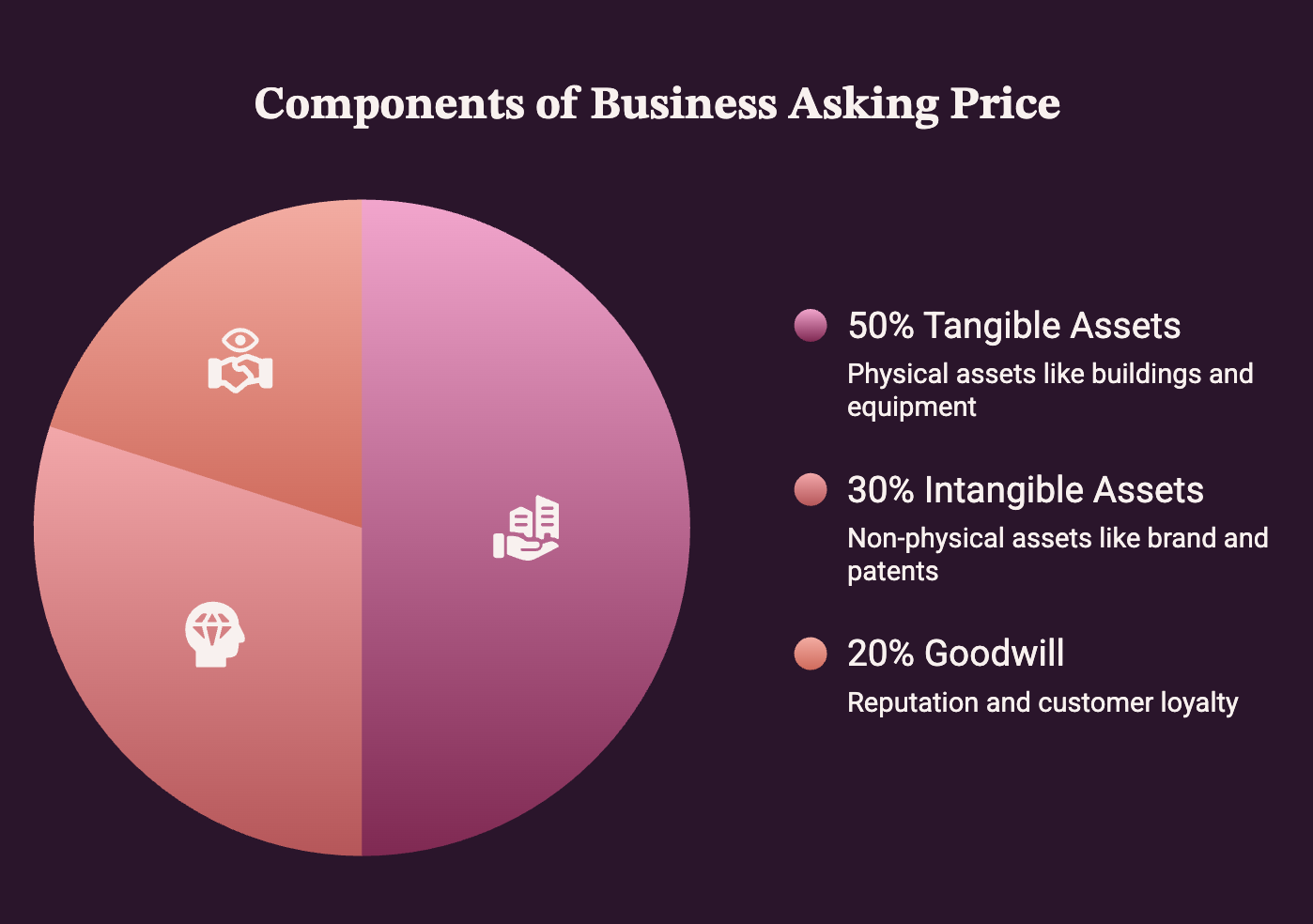
The asking price is not a valuation. A valuation is a professional estimate of worth. The asking price is a commercial position you take in a market.
The two are related, but they do different jobs. A valuation exists to inform you. An asking price exists to attract the right buyer and open a negotiation you can win.
There is also a third number, and it is the one that matters. That is the completion price. It arrives after due diligence, after working capital adjustments, and after any money is deferred.
So four numbers exist in every deal. The asking price you publish. The offer a buyer makes. The agreed price written into heads of terms. The completion price that actually lands in your account.
The gap between the first and the last is not a failure. It is normal. The seller’s job is to keep that gap narrow and predictable, not to pretend it does not exist.
Sellers who understand how to value a business before they set a figure tend to hold their nerve in negotiation. Sellers who do not, drift downwards under pressure, because they have no evidence to hold on to.
How you present the number matters
You have choices beyond a single figure. A fixed asking price signals confidence and invites direct offers. A guide price signals flexibility and invites a range.
Offers in excess of a figure sets a floor. It works when demand is strong and the business is unusual. It backfires when the floor is too high, because buyers read it as a warning rather than an invitation.
Price on application hides the number. It filters out casual browsers. It also removes you from the shortlist of every buyer who screens listings by price, which is most of them.
For the great majority of owner-managed businesses, a clear fixed figure plus stock at valuation performs best. It tells a buyer immediately whether the business is fundable.
Be honest with yourself about one thing. There is no single correct asking price. There is a defensible range, and a position you choose within it.
Start With Adjusted Profit, Not Turnover
Buyers do not buy turnover. They buy the profit that reaches their pocket after they have replaced you.
Turnover multiples mislead sellers badly. A 900,000 pound turnover restaurant with 20,000 pounds of profit is worth a fraction of a 300,000 pound turnover consultancy earning 140,000 pounds. Turnover tells a buyer how busy you are. Profit tells them what they are buying.
So the first job is to work out adjusted net profit. This is your filed profit, corrected for costs a new owner would not carry, and for costs you have been quietly avoiding.
Add-backs are the costs in your accounts that exist because it is your business, not because the business needs them. Take them out and you show the buyer the true earning power of the trade.
The add-back schedule, line by line
Here is a typical schedule for a limited company with 1.1 million pounds of turnover.
Line | GBP |
Net profit before tax, as filed | 96,000 |
Add back director salary of 90,000 against a market rate of 55,000 | 35,000 |
Add back personal motoring run through the company | 6,200 |
Add back one-off legal fees on a lease dispute | 8,500 |
Add back director pension contribution | 20,000 |
Add back non-trading costs, including a family phone contract | 3,400 |
Add back salary paid to a spouse who does not work in the business | 12,000 |
Adjusted net profit | 181,100 |
Two rules keep this honest. Only add back what you can evidence. Only add back what genuinely disappears on completion.
Note the salary line carefully. You do not remove your entire salary. You remove the amount above the market rate for the job you actually do.
If a buyer must hire a manager on 55,000 pounds to replace you, that 55,000 pounds stays as a cost. If two family members each draw 40,000 pounds for one real job, one salary is an add-back and one is not.
Sellers who refuse to accept this lose credibility fast. A buyer who catches one dishonest add-back will discount everything else you claim, including the honest lines.
What buyers will not accept as an add-back
Recurring costs dressed up as one-offs are the most common rejection. Legal fees that appear in three consecutive years are not exceptional. They are a feature of your business.
Deferred maintenance is another. If the roof needs replacing and you have not replaced it, the buyer prices the roof. You cannot add back the cost of work you never did.
Understated wages fall into the same trap. If you pay below the going rate for a role, or rely on unpaid family labour, the buyer restates the wage bill upwards.
Marketing spend cut in the final year to flatter profit is spotted immediately. Buyers read three years of accounts, not one. A profit spike created by cutting investment reduces the multiple rather than raising the price.
EBITDA, and when to use it
EBITDA takes the same figure a step further. It stands for earnings before interest, tax, depreciation and amortisation.
Add interest of 4,000 pounds and depreciation of 26,000 pounds to the figure above, and adjusted EBITDA becomes 211,100 pounds. That is a bigger number, and it is tempting. It is also the right number only in certain cases.
Use EBITDA when the business carries meaningful debt or heavy equipment, and when the buyer is likely to be a company rather than an individual. Use adjusted net profit for smaller owner-run firms where the buyer is a person taking over the job.
Whichever you choose, apply the multiple to that same figure every time. Mixing an EBITDA-based multiple with a net-profit-based earnings figure inflates the price by a third and fools nobody.
Your filed accounts are public. Anyone can get information about a company from Companies House, so a buyer has already seen the numbers you filed. Every adjustment must reconcile back to those accounts.
Weight the years correctly
One year is not a trend. Take three years of adjusted profit and weight them.
A common approach gives three parts to the most recent year, two to the year before, and one to the year before that. It rewards recent improvement without pretending that a single strong year is permanent.
If the trend is downward, expect the buyer to weight the latest year even more heavily. A falling profit line caps the multiple regardless of how good the earlier years were.
Ready to take the next step?
Contact our team of experienced business sale professionals to discuss your specific situation and explore how we can help you achieve your business sale objectives.
Choosing The Right Multiple For Your Sector
The multiple is the number you apply to adjusted profit. Choosing it is judgement, not arithmetic.
We do not publish precise sector averages, because no official UK source publishes them. What follows is professional judgement drawn from the owner-managed market, and it is a range, not a rule.
Small leasehold retail and hospitality businesses commonly trade at low multiples, often between 1 and 2.5 times adjusted profit. Trades and service firms with repeat work sit higher. Contracted service businesses and small technology firms with recurring income reach further still.
What pushes the multiple up
Certainty pushes it up, and nothing else does.
Recurring revenue on written contracts is the strongest driver. A buyer can forecast it, and a lender can lend against it. Long remaining contract terms extend that certainty.
A spread of customers matters almost as much. Fifty clients at 2 per cent each is a far safer business than five at 20 per cent each, at identical profit.
A management team that stays after completion supports the price. So do stable gross margins across three years, and a growth trend the accounts can prove without explanation.
What pulls the multiple down
Risk pulls it down, and buyers price risk ruthlessly.
One customer worth 40 per cent of turnover is the classic problem. Verbal agreements with no notice period are almost as bad. Walk-in trade with no customer data gives the buyer nothing to forecast.
Margins that swing between 18 and 34 per cent suggest the pricing is not under control. Staff turnover above the norm for the sector suggests the same about the culture.
And above everything, an owner who is the business. That subject deserves its own section, because it costs more than all the others combined.
Two firms, same profit, different price
Compare two businesses with identical adjusted profit.
Business | Adjusted profit (GBP) | Multiple | Goodwill (GBP) |
IT support firm, 78 per cent recurring contracts | 155,000 | 4.0 | 620,000 |
Homeware shop, walk-in trade only | 155,000 | 1.7 | 263,500 |
A 356,500 pound gap on the same earnings. The buyer is not paying for last year’s profit. They are paying for the probability of next year’s.
Different valuation approaches can also produce different answers on the same set of accounts, which is why the business valuation methods used in the UK are worth understanding before you fix a multiple.
Owner Dependency And Why It Costs You Money
Owner dependency is the single largest destroyer of value in UK SME sales.
Put yourself in the buyer’s chair. They are borrowing to buy. They will meet the loan payments from the profit. If half the customers only deal with you, that profit is not safe.
So the buyer does one of three things. They cut the multiple. They push a large slice of the price into an earn-out that ties you in. They walk away.
Ask yourself a plain question. If you were unwell for eight weeks, what would happen? If the answer is that turnover falls, the business is priced on you, not on itself.
What to fix, and roughly how long it takes
Move key customer relationships to a named account manager. Introduce them properly, in person, and stop copying yourself into every email. Expect six months before customers stop asking for you.
Document your pricing rules and your quoting method. If the price of a job lives in your head, the buyer is buying your head. Written rules take a few weeks to draft and a quarter to embed.
Put your top customers on written contracts with notice periods. This is the fastest lever available. It converts assumed revenue into contracted revenue, and it directly lifts the multiple.
Promote someone to run the day-to-day, then let them make mistakes without stepping in. This is the hardest part and the slowest. Allow a year.
The payoff, in money
Twelve to eighteen months of that work changes the multiple. It is the highest return work a seller can do.
A shift from 2.4 times to 3.2 times on 180,000 pounds of adjusted profit adds 144,000 pounds to the price. No marketing campaign, no new product and no cost-cutting exercise produces that return in the same period.
There is no shortcut. Buyers test this in due diligence by talking to your staff and reading your customer contracts. The story has to be true.
Ready to take the next step?
Contact our team of experienced business sale professionals to discuss your specific situation and explore how we can help you achieve your business sale objectives.
Assets, Stock, And What Sits Outside The Asking Price
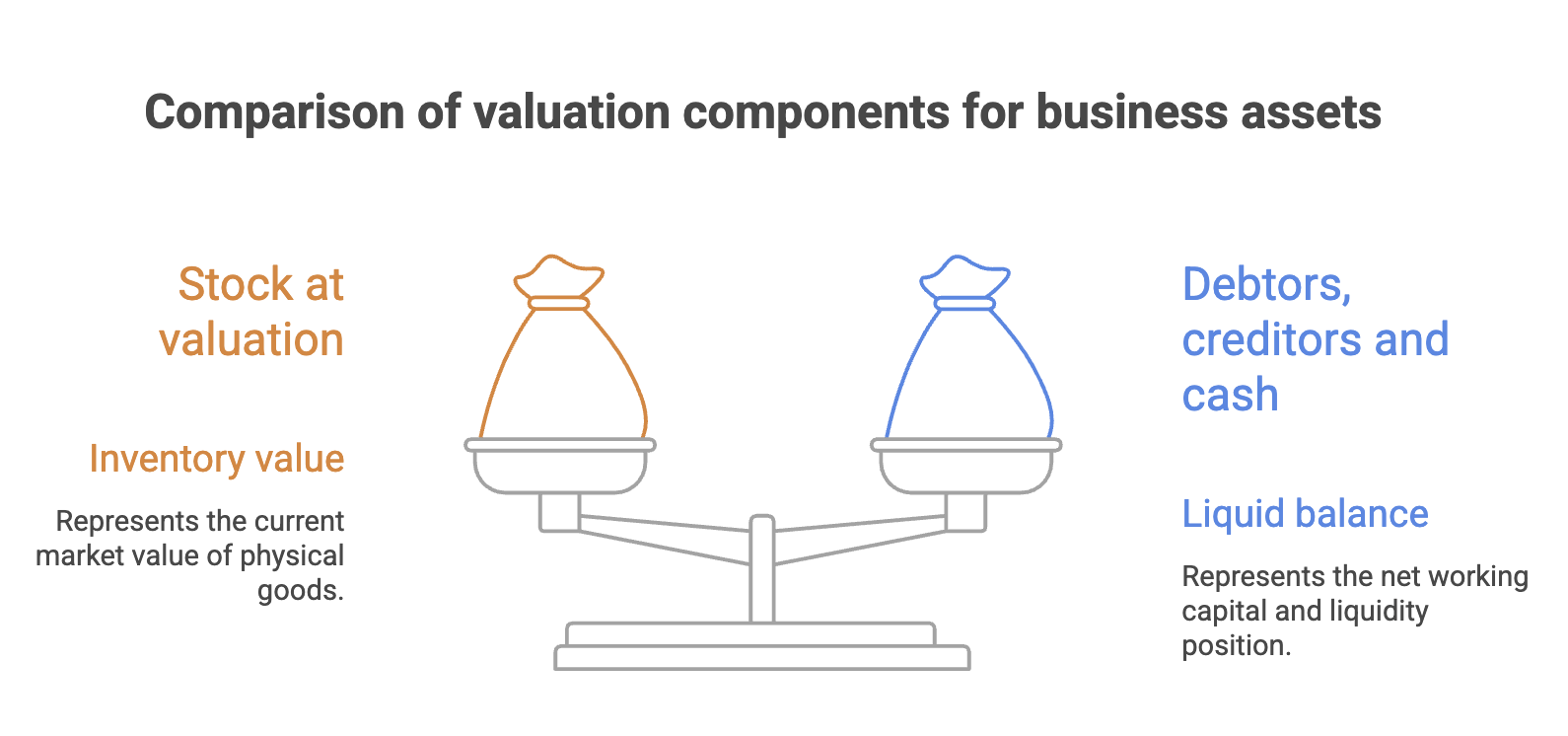
A profit multiple already buys the assets the business needs to make that profit. This is where sellers double count.
The tills, the racking, the workshop tools, the computers, the vans on the road. All of it is assumed inside the multiple. Add it again on top and you have priced the same thing twice.
Some assets do sit outside. A freehold property is separate. Surplus vehicles not used in the trade are separate. Cash at bank is usually separate. So is any significant asset the business owns but does not need.
Stock at valuation
Stock is handled on its own, and this is standard UK practice. The phrase you will see is stock at valuation, often shortened to SAV. It means the buyer pays for saleable stock separately, at cost, counted on the day of completion.
Stock is treated this way because it moves. A shop with 30,000 pounds of stock in November may hold 9,000 pounds in January. Baking the figure into the asking price would make the price wrong on the day it mattered.
Only good stock counts. Damaged goods, obsolete lines and dead ranges are usually excluded, or discounted heavily by agreement.
Agree the method before completion, not on the day. Decide who counts, whether it is at cost excluding VAT, and what age of stock is written off. A stocktake argument on completion morning has killed otherwise finished deals.
Debtors, creditors and cash
Debtors and creditors normally stay with the seller in an asset sale. You collect what you are owed. You pay what you owe.
In a share sale they travel with the company, and the price is adjusted for them. Most share sales are agreed on a cash free, debt free basis. That means the seller takes the surplus cash and clears the borrowing, and the price assumes a normal level of working capital.
Normal is the word that causes disputes. Buyers calculate an average working capital level over twelve months, then adjust the completion price up or down against it.
So a business with 620,000 pounds agreed can complete at 588,000 pounds because debtors were unusually low that month. Model this before you sign heads of terms, not after.
Property And Lease Terms
Property changes the number more than most sellers expect.
If you own the freehold, decide first whether you are selling it. Many sellers keep it and grant the buyer a lease, taking rental income into retirement. That is a legitimate choice, but it changes the price you advertise.
Here is the trap. If the business occupies your freehold rent free, its profit is inflated. A buyer who must pay rent will not accept that profit figure.
So deduct a notional market rent before applying the multiple. Then add the freehold value, assessed by a qualified surveyor, on top.
Line | GBP |
Adjusted EBITDA, precision engineering firm | 240,000 |
Less notional market rent on the freehold unit | (35,000) |
Rebased earnings | 205,000 |
Multiple applied, 3.5 times | 717,500 |
Add freehold value, surveyor assessed | 550,000 |
Indicative asking price | 1,267,500 |
When you are leasehold
The remaining term does most of the work. A lease with three years to run compresses the price hard. The buyer cannot secure funding against an asset that may vanish.
Ten years or more, with security of tenure, supports the price. Anything under five years should be renegotiated before you go to market, not during the sale.
Read the lease properly, and read it now. Check the rent review pattern, and whether reviews are upward only. Check any break clause, and who is entitled to exercise it.
Check whether the landlord’s consent to assign can be refused, and on what grounds. Check for personal guarantees that may follow you after completion.
Sellers regularly discover in week ten that their landlord will not assign. The deal collapses and the listing is burned. Ask the landlord the question before you list, in writing.
The cafe example
Here is how a short lease and walk-in trade combine.
Line | GBP |
Turnover | 420,000 |
Net profit as filed | 48,000 |
Add back owner salary above market rate | 12,000 |
Add back personal motoring and one-off legal fees | 5,000 |
Adjusted net profit | 65,000 |
Multiple applied, 1.6 times, walk-in trade, owner behind the counter | 104,000 |
Fixtures, fittings and equipment | included |
Asking price, rounded | 105,000 |
Stock, at valuation on completion, approximately | 4,000 |
The same profit in a business with a fifteen year lease and a manager in place supports a materially higher multiple. The trade did not change. The risk did.
The first mistake is pricing on turnover. A seller multiplies turnover by a remembered figure and arrives at a number no buyer can fund. The listing sits, and the price becomes a public statement that the seller is not serious.
The second is adding goodwill twice. The multiple already pays for goodwill. Adding a separate goodwill line on top inflates the price by tens of thousands, and signals to any accountant that the seller does not understand the method.
The third is refusing to strip out owner salary properly. Sellers add back the whole salary, including the part that pays for the work they genuinely do. The buyer’s accountant deducts a manager’s wage, the profit falls, and the price falls with it.
The fourth is pricing on a single good year. One strong twelve months after two weak ones is not a trend. Buyers weight three years, and they weight the most recent one heaviest.
The fifth is including a short lease at full value. A three year lease does not support the same price as a fifteen year one, and no amount of optimism changes that.
The sixth is ignoring customer concentration. If one client is 40 per cent of turnover, the buyer prices the risk that the client leaves with you. The multiple drops, or the money moves into an earn-out.
The seventh is testing the market with a high number to see what happens. Buyers do not counter-offer on overpriced listings. They move on, and they do not come back when you reduce.
The eighth is letting the listing go stale. Buyers watch how long a business has been advertised. Once a listing has aged, offers arrive below asking as a matter of course, and the seller has lost the negotiation before it opened.
Market Conditions And Timing
The same business fetches different prices in different years. Nothing inside it needs to change.
Buyer confidence moves with the wider economy. When confidence falls, buyers demand more certainty and offer less. When it rises, competition returns and prices firm up.
Lending conditions matter most for the middle of the market. Most buyers of owner-managed businesses borrow part of the price. The cost and availability of that borrowing sets the ceiling on what any buyer can pay.
The Bank of England’s decisions feed directly into that cost. In June 2026 the Monetary Policy Committee voted to hold Bank Rate at 3.75 per cent. Higher rates mean higher loan repayments, and higher repayments mean a buyer can service a smaller debt on the same profit.
Sector demand runs on its own cycle. Care, waste, specialist manufacturing and compliance-driven services have attracted steady buyer interest. Parts of retail and casual hospitality have not.
Supply matters too. The UK had around 5.7 million private sector businesses at the start of 2025, according to the Department for Business and Trade’s business population estimates, and the great majority are small. A large cohort of owners is approaching retirement together. More businesses on the market means more choice for buyers, and choice suppresses price.
None of this is a reason to panic, and none of it is a reason to rush. It is a reason to be realistic about the year you are actually selling in, rather than the year you first imagined selling in.
What a Broker Brings to the Valuation Process
An experienced broker has access to real transaction data from businesses they have actually sold – not published indices or theoretical averages derived from quoted company data. This comparable transaction evidence, combined with deep sector-specific knowledge, produces materially more accurate valuations than a generic formula applied without reference to the current state of the market. Brokers also identify value drivers that owners are often too close to see clearly: they know which characteristics buyers in a given sector are willing to pay a premium for, and they can position those characteristics prominently in the sales process. Working with a broker that has a long track record of completing transactions across multiple sectors – as Blacks Brokers does across the UK sale process – is one of the most reliable ways to ensure that the valuation placed on a business reflects what buyers are actually paying rather than what the seller hopes to receive.
Deal Structure Changes The Number
Two offers arrive. One is 700,000 pounds. One is 620,000 pounds. Which is better?
You cannot answer yet. Structure decides it.
Cash on completion is money in your account on the day. It carries no risk. It is the cleanest form of consideration, and it is the benchmark against which everything else is measured.
Deferred consideration is an agreed sum paid later, usually in instalments over one to three years. The amount is fixed, but payment depends on the buyer remaining solvent and willing. Take security where you can, and take advice on what security is worth.
An earn-out is different, and riskier. The extra money is paid only if the business hits agreed targets after you have gone. You will no longer control the business that must hit them.
Seller finance means you lend the buyer part of the price. You become a creditor of your own former business, ranking behind the bank.
Comparing two offers properly
Element | Offer A (GBP) | Offer B (GBP) |
Headline price | 700,000 | 620,000 |
Cash on completion | 400,000 | 620,000 |
Deferred over 3 years, profit-linked earn-out | 300,000 | 0 |
Certain money on day one | 400,000 | 620,000 |
Conditional money, dependent on future trading | 300,000 | 0 |
Offer B is worth more to most sellers. It is certain, it is immediate, and it is not conditional on a buyer you cannot control.
A headline number means nothing until you know when it arrives and what has to happen first. If you take an earn-out, negotiate the definitions harder than the number. Define profit. Define who controls costs. Define what happens if the buyer merges the business into another.
Set your asking price with structure in mind, and say so. State plainly that the figure assumes cash on completion. That gives you a reason to hold firm when a buyer proposes deferring half of it.
Structure also shapes the timetable, which is one reason it is worth understanding how to sell a business before you accept an offer that looks generous on paper.
Tax Sits Between The Price And Your Pocket
The price is not the proceeds. Tax sits in between, and the structure of the sale decides how much.
An asset sale means the buyer purchases the trade and specific assets. The legal entity stays with you. Buyers often prefer this, because they leave unknown liabilities behind.
A share sale means the buyer purchases the shares in your limited company. Everything travels with it, good and bad. Sellers usually prefer this, and buyers price the risk accordingly.
The tax outcome differs sharply. In an asset sale by a limited company, the company is taxed on the gains, and you are taxed again when you extract the money. In a share sale, you as shareholder are taxed on your gain once.
Capital Gains Tax applies to gains on a share sale. Business Asset Disposal Relief can reduce the rate on qualifying gains, up to a lifetime limit of 1 million pounds. According to HMRC guidance on Business Asset Disposal Relief, qualifying disposals made on or after 6 April 2026 are taxed at 18 per cent.
Conditions apply, and they are not trivial. Broadly, you must have met them for at least two years to the date of disposal. Sole traders, partners and shareholders each face different tests.
The relief is per person. Two spouses who both qualify each have their own lifetime limit. That is a planning point, and it needs setting up long before a buyer appears.
Do not design your sale around tax alone. But do not ignore it either. A share sale at 620,000 pounds can leave you with more than an asset sale at 680,000 pounds.
Get advice from a qualified tax adviser before you agree heads of terms. Once the structure is signed, it is very hard to unwind.
Ready to take the next step?
Contact our team of experienced business sale professionals to discuss your specific situation and explore how we can help you achieve your business sale objectives.
Common Asking Price Mistakes UK Sellers Make
- The first mistake is pricing on turnover. A seller multiplies turnover by a remembered figure and arrives at a number no buyer can fund. The listing sits, and the price becomes a public statement that the seller is not serious.
- The second is adding goodwill twice. The multiple already pays for goodwill. Adding a separate goodwill line on top inflates the price by tens of thousands, and signals to any accountant that the seller does not understand the method.
- The third is refusing to strip out owner salary properly. Sellers add back the whole salary, including the part that pays for the work they genuinely do. The buyer’s accountant deducts a manager’s wage, the profit falls, and the price falls with it.
- The fourth is pricing on a single good year. One strong twelve months after two weak ones is not a trend. Buyers weight three years, and they weight the most recent one heaviest.
- The fifth is including a short lease at full value. A three year lease does not support the same price as a fifteen year one, and no amount of optimism changes that.
- The sixth is ignoring customer concentration. If one client is 40 per cent of turnover, the buyer prices the risk that the client leaves with you. The multiple drops, or the money moves into an earn-out.
- The seventh is testing the market with a high number to see what happens. Buyers do not counter-offer on overpriced listings. They move on, and they do not come back when you reduce.
- The eighth is letting the listing go stale. Buyers watch how long a business has been advertised. Once a listing has aged, offers arrive below asking as a matter of course, and the seller has lost the negotiation before it opened.
How To Arrive At Your Final Asking Price
Work in three steps, in order. Range first. Position second. Headroom third.
- Step one is the range. Take adjusted net profit, averaged across three years and weighted towards the most recent. Apply a low multiple and a high multiple for your type of business. That gives you a floor and a ceiling.
- Step two is your position within it. Score yourself honestly on recurring revenue, contract length, customer spread, owner dependency, staff retention, margin stability and growth trend. Strong on most, sit in the upper half. Weak on owner dependency, sit lower than feels comfortable.
- Step three is headroom. Add a modest margin for negotiation, usually 5 to 8 per cent. Enough to concede something meaningful. Not so much that serious buyers never call.
Then add what sits outside, and say so plainly in the listing.
The contracted business, for comparison
Line | GBP |
Commercial cleaning company, turnover | 1,200,000 |
Adjusted net profit | 168,000 |
Multiple applied, 3.25 times, three year contracts, operations manager in post | 546,000 |
Cash free, debt free basis, share sale | 546,000 |
Asking price, rounded | 550,000 |
Largest customer accounts for 9 per cent of turnover. Same country, same year, roughly the same profit as the engineering firm’s rebased earnings. A completely different multiple, because the risk profile is different.
The final worked example
Here is a heating and plumbing contractor, sold as a limited company.
Line | GBP |
Adjusted net profit, three year weighted average | 210,000 |
Range at 2.5 times | 525,000 |
Range at 3.5 times | 735,000 |
Position chosen, 2.8 times, owner still holds key accounts | 588,000 |
Negotiation headroom at 7 per cent | 41,160 |
Asking price, rounded | 625,000 |
Vans and tools, owned outright | included |
Stock, at valuation on completion, approximately | 12,000 |
The listing reads: 625,000 pounds plus stock at valuation. The seller can defend every line of it under questioning.
Notice what the seller did not do. They did not price at 735,000 pounds because the ceiling existed. They did not add the vans on top. They did not pretend the owner was replaceable.
Before you commit, have someone independent run the numbers. A free business valuation gives you a second view from people who see what buyers actually pay, rather than what sellers hope for.
If the independent figure is well below yours, that is useful information. It is cheaper to learn it now than after nine months of silence.
Frequently Asked Questions
Most owner-managed UK businesses sell for between 1 and 5 times adjusted net profit. Small leasehold retail and hospitality sit at the low end. Contracted service firms and small technology businesses sit at the top. No official body publishes averages, so treat any precise figure with caution. Your multiple depends on risk, not on your sector alone.
Start with adjusted net profit, then apply a multiple that reflects your risk profile. Take three years of accounts, weight the most recent year heaviest, and add back costs a new owner would not carry. Then add assets that sit outside the multiple, such as freehold property. Stock is counted separately at completion.
Adjusted net profit is your filed profit corrected for costs that exist because you own the business. It matters because buyers price the earnings a new owner would actually receive. Typical adjustments include owner salary above market rate, personal motoring, one-off legal fees, director pension contributions, and salaries paid to family who do not work in the business.
Use adjusted net profit for small owner-run firms where the buyer is an individual taking over the job. Use adjusted EBITDA where the business carries real debt or heavy equipment, or where the buyer is likely to be a company. The important rule is consistency. Apply the multiple to the same earnings figure every time.
No, and this is a common and costly error. The multiple you apply to adjusted profit already pays for goodwill. Goodwill is the value of reputation, customer relationships and trading history, which is exactly what the multiple prices. Adding a separate goodwill figure counts the same asset twice and tells buyers you do not understand the method.
No. Stock is normally sold separately at valuation, counted on the day of completion and paid for at cost. This is standard UK practice. Advertise your price as a figure plus stock at valuation. Only saleable stock counts. Damaged, obsolete or dead lines are usually excluded or discounted, so agree the counting method in advance.
Stock at valuation means the buyer pays for usable stock on top of the agreed price, at cost, counted on completion day. Stock levels move with the season, so fixing the figure months earlier would make the price wrong when it mattered. Agree in advance who counts it, whether cost excludes VAT, and how old stock is treated.
There is no reliable timescale, and nobody can promise one. Well-priced, well-prepared businesses attract enquiries within weeks. Overpriced ones can sit for a year. Completion usually takes several months after an offer, because due diligence and legal work take time. Preparing your accounts and your lease before listing shortens the process more than anything else.
An asset sale transfers the trade and named assets, leaving the legal entity with you. A share sale transfers the company itself, including its history and liabilities. Buyers often prefer asset sales. Sellers often prefer share sales. The tax outcome differs significantly, so take advice from a qualified adviser before you agree the structure.
Usually yes, if you sell shares or sell business assets as a sole trader or partner. Business Asset Disposal Relief may reduce the rate on qualifying gains, up to a lifetime limit of 1 million pounds. Conditions apply, and they generally require two years of qualifying ownership. Take advice from a qualified tax adviser before agreeing heads of terms.
Often not. Where a business is sold as a going concern and the buyer continues the same trade, the transfer can fall outside the scope of VAT. HMRC sets specific conditions, including VAT registration requirements for the buyer. Do not assume the treatment. Confirm it with your accountant before you agree the price and the completion mechanics.
Yes, but adjust the profit first. If the business occupies the property rent free, its profit is overstated. Deduct a notional market rent, apply your multiple to the rebased figure, then add the surveyor-assessed property value. Alternatively, keep the freehold and grant the buyer a lease. That produces a lower price and an income stream.
A short lease compresses the price, sometimes severely. Buyers cannot borrow confidently against premises they may lose within a few years. Under five years remaining is a serious problem for most trading businesses. Renegotiate the term before you go to market. Also check the rent review pattern, any break clause, and whether the landlord can refuse to assign.
Usually the value of its assets, less its liabilities, and sometimes less than that. Without adjusted profit there is nothing for a multiple to work on. Buyers will look at equipment, property, stock and any contracted income. If the business is loss-making and asset-light, the realistic value may be close to nil.
Yes, and it usually sells for a lower multiple. If one client is 40 per cent of turnover, a buyer prices the risk that the client leaves when you do. Expect a reduced multiple, a larger earn-out, or both. Spreading revenue across more customers before you list is the most direct fix.
Around 5 to 8 per cent above your defensible figure is normal. That is enough to concede something meaningful without inviting a low first offer. Larger padding backfires. Buyers screen listings by price, and a number their lender will not fund removes you from consideration before anyone picks up the phone.
Reduce it, but only once, and only after checking the listing itself. Poor photographs, vague financials and a hidden lease term suppress enquiries just as effectively as a high price. Repeated small reductions signal weakness and invite low offers. One decisive reduction, supported by a fresh valuation, works better than three token ones.
Reducing owner dependency. Move customer relationships to named staff, put key clients on written contracts, and appoint someone to run daily operations. Twelve to eighteen months of this can lift the multiple materially. On 180,000 pounds of profit, moving from 2.4 to 3.2 times adds roughly 144,000 pounds.

Author - John Gaskell
John is a senior member of the Blacks Brokers team with extensive experience leading successful national sales operations. He plays a central role in developing the team's approach to client service, drawing on a deep belief that positivity, care and drive are the defining qualities of any great salesperson. John delivers comprehensive training across the organisation that instils a client-first ethos at every level, ensuring consistency of service throughout every transaction. His focus is always on achieving the best possible outcome for each client the business serves.